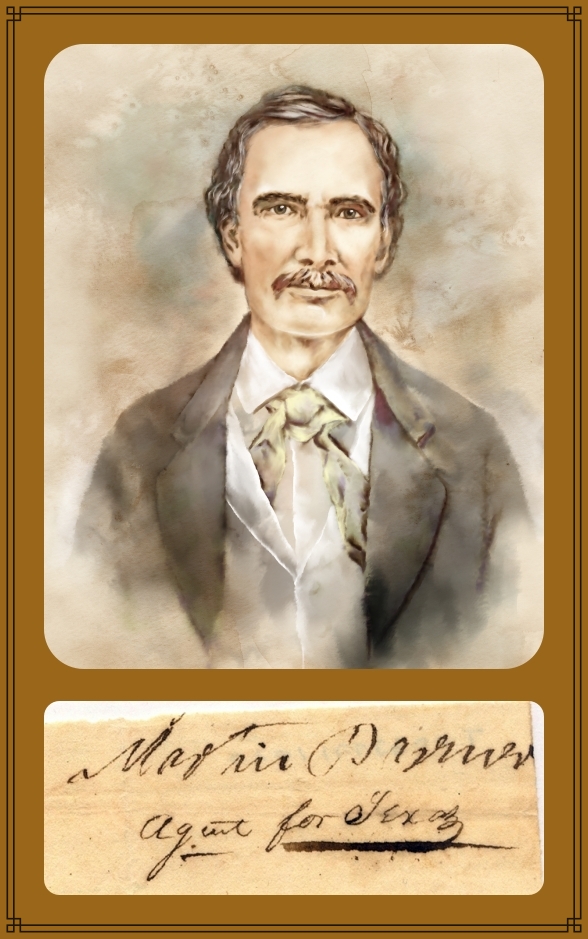
Martin Parmer"Agent for Texas"
Collection of K. K. Searle Martin Parmer's Signature from 1836 Republic of Texas Scrip
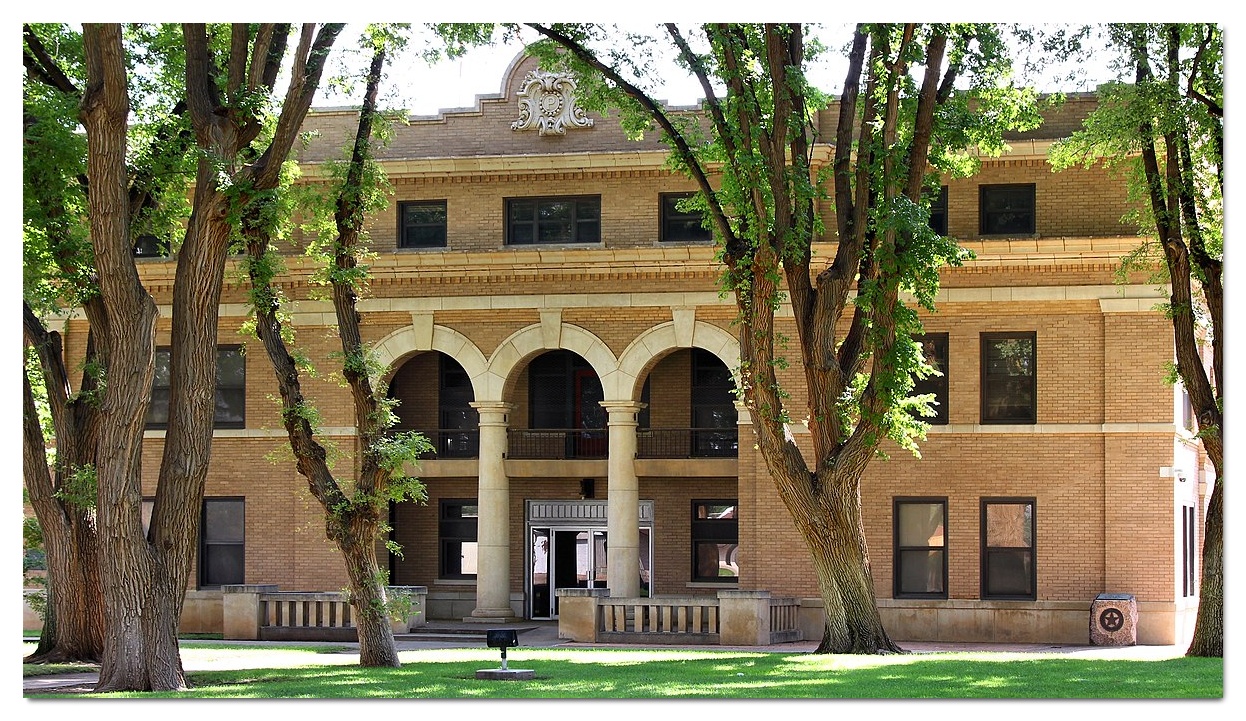
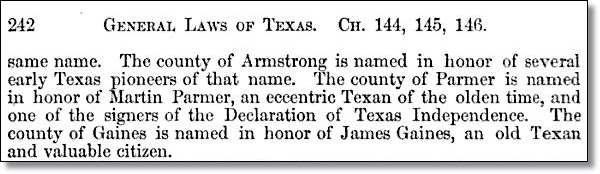
The county of Parmer is named in honor of Martin Parmer, an eccentric Texan of olden time, and one of the signers of the Declaration of Texas Independence. The General Laws of Texas
"A small party of infatuated madmen at Nacogdoches have declared Independence and invited the Indians from the Sabine to the Rio Grande to join them and wage a war of Murder, plunder and desolation on the innocent inhabitants of the frontier-- The leader of this party is Martin Parmer..."
Stephen F. Austin to the Citizen's of Victoria Letter dated January 1, 1827 regarding the Fredonian Rebellion
Watercolor of Martin Parmer Commissioned by Kameron K. Searle - Collection of K. K. Searle
Martin Parmer by: Kameron Searle Martin Parmer was one of the most fascinating and eccentric characters in the early history of Missouri, Mexican colonial Texas and the Republic of Texas. Martin Parmer was born in Virginia, but lived most of his life on the American frontier. Parmer was a frontiersman, pioneer, Indian fighter, Indian agent, State Representative, State Senator, rebel, soldier, delegate, a judge and founding father of a country - The Republic of Texas.
Before coming to Texas in 1825, Martin Parmer was a frontiersman in Missouri. For some amazing accounts of Martin Parmer adventures on the frontier of Missouri, read Tom Parmer's 1874 booklet Fifty-Five Years Ago in the Wilderness or the Old Ringtail Panther of Missouri. Click on the image above, print a free copy and read what Tom Parmer wrote about his father, Martin Parmer. Not wishing these stories to be forgotten, Tom Parmer published this booklet at his own expense and gave copies to family members. Tom lived an interesting life himself. For many years, he and his brother William were overseers of Sam Houston's plantation.
Martin Parmer's Grave in the Texas State Cemetery, Austin, Texas Historian, Daniel A. Hill, is currently preparing a book for publication in the near future concerning the amazing life of Martin Parmer. Hill's book focuses much needed attention on Martin Parmer's early activities from his birth in Virginia in 1778 to his arrival in Texas in 1825. This web page will begin with some of Martin Parmer's activities in Missouri, but will focus primarily on his activities in Texas.
Martin Parmer in Missouri
Missouri frontier attire of the type Martin Parmer would have worn. From a drawing by George Catlin from A History of Missouri: From the Earliest Explorations and Settlements until the Admission of the State into the Union, Vol. III, by Louis Houck, (Chicago: R. R. Donnelly & Sons, 1908) p. 122.
Martin Parmer in Missouri History Books Many Missouri history books make mention of Martin Parmer and his activities in the Missouri Territory and the early State of Missouri. Upon his arrival in Texas, many of the settlers had already heard of Martin Parmer and were familiar with his exploits in Missouri.
A History of Missouri by Louis Houck
"Martin Palmer hunted and and trapped in the limits of the present Carroll county in 1817 and in 1819, John Stanley and William Turner settled near the place where is now located Carrolton." A History of Missouri: From the Earliest Explorations and Settlements until the Admission of the State into the Union, Vol. III, by Louis Houck, (Chicago: R. R. Donnelly and Sons, 1908), p. 157.
Centennial History of Missouri In the Centennial History of Missouri, Volume 2, by William Barlow Stephens, on page 502, we find the following account by General Slack regarding Martin Parmer.
General Slack's Account
History of Ray County Missouri Article from history of Ray County Missouri.
Early 1820's Francis Mason
See pages 165 and 166 of The Story of a Working Man's Life, by Francis Mason, 1870.
Martin Parmer in Newspapers in Missouri Martin Parmer and his exploits were the subject of numerous newspaper articles in the early 1820's in Missouri. 1820 McElwee Incident
INDIAN HOSTILITY.
See page 3 of the St. Louis Enquirer, newspaper, August 9, 1820. In 1820, Martin Parmer is referred to as a Captain. As we will see below, by 1823, he is referred as Colonel. This Mucklwee newspaper article was printed all over the United States. This 1820 newspaper article differs in some material ways from the McElwee story related by Thomas Parmer in his booklet published in 1874, Fifty-Five Years Ago in the Wilderness or the Old Ring Tail Panther of Missouri.
Ioway Indians
Re-scan this image. Part of it is cut off at the top.
See page 3 of the Richmond Enquirer, newspaper published in Richmond Virginia, Friday, July 4, 1823, Vol. XX, No. 17. The source reported for this article was Franklin, Missouri.
Revenge killing
Transcribe the article above and show source
Martin Parmer in the Missouri Constitutional Convention? Though Martin Parmer is often credited with being a member of or delegate to the 1820 Missouri Constitutional Convention of Missouri (Ex. See Martin Parmer's headstone in the Texas State Cemetery which reads, "While serving in this office Parmer was named as a delegate to the Missouri Constitutional Convention of 1821"), I have never seen any primary historical evidence that proves Parmer participated. Parmer's headstone does not even appear to get the year of the convention correct. Here is a link to the names of the delegates to the 1820 Missouri Constitutional Convention. http://politicalgraveyard.com/geo/MO/ofc/cncn1.html Parmer's name does not appear anywhere in the document. If you have any evidence that Martin Parmer served as a delegate or member of the 1820 Missouri Constitutional Convention, please let me know at ksearle1@pdq.net . Thank you.
1825 Col. Palmer "Gone to Texas"
National Gazette and Literary Register Philadelphia, Thursday, December 29, 1825
Collection of K. K. Searle
The term French leave is defined as "leave of absence without permission or without announcing one's departure." Nimrod Indian Agent for William Clark of Lewis and Clark.
Martin Parmer in Texas
Martin Parmer in Texas History Books
Many Texas history books make mention of Martin Parmer and his activities. Henderson Yoakum We find the following information about Martin Parmer in Henderson Yoakum's History of Texas, Volume 1, on page 247.
This information appears to have come from either Thomas Palmer or William Palmer. Both of these sons of Martin Parmer were overseers working for Sam Houston at the time Yoakum wrote his history of Texas in close association with Sam Houston. As Thomas would make several efforts to write the history of Martin Parmer's life, the son referred to here is probably Thomas Palmer. to give some idea as to how close Sam Houston's family was to the family of Thomas Parmer, I include an excerpt from a letter written by Margaret Lea Houston to her husband, Sam Houston, in 1850.
Homer Thrall
The Bean Affair
The Robert Leftwich Affair From court papers in Martin Parmer's lawsuit against Robert Leftwich, we learn that Parmer's involvement with Peter Ellis Bean's wife must have gone on for some time. Not just a couple of days as reported in various histories. Parmer was not just suing in his name, but also in the name of Candace Bean.
Fredonian Rebellion ORDER TO THE SERGEANT OF THE GUARD You are commanded to bring forthwith every American in the village and compel him to bear arms- if he refuses, put him under arrest.
Dear and Respected Friend: Two men who have just arrived from Nacogdoches make the following report to me. The party who went to Nacogdoches was led by Martin Parmer, who took the title of Colonel of militia between the Trinity and the Sabine.
Resolved:--That the mad conduct of a set of desperate men, headed by Martin Parmer, otherwise called the Ringtailed Panther, is such as should excite the most decided disapprobation of every good, well meaning and respectable citizen of this Colony.
Martin Parmer Started the Fredonian Rebellion The primary source evidence strongly suggests that Martin Parmer was the spark that set off the Fredonian Rebellion in 1826. For over 185 years, historians have speculated as to the reason Martin Parmer rode into Nacogdoches in November of 1826 and did the many unusual things he did. A close study of the Robert Bruce Blake Research Collection finally revealed the reason Martin Parmer took the actions he did.
Otto Askins Affidavit Accusing Martin Parmer of Killing Moton Askins On October 15, 1826, Otto Askins swore out an affidavit before Samuel Norris, the Alcalde of the District of Nacogdoches, stating that Martin Parmer shot and killed his brother Moton (Mote) Askins. This affidavit and the arrest warrant issued as a result of it would be the spark that would start the Fredonian Rebellion. The affidavit reads as follows:
See the Robert Bruce Blake Research Collection, 75 Volumes, Compiled by R. B. Bake, Compiled in the Eugene C. Barker Texas History Center Archives Collection 1958-1959, Volume XI, II. Nacogdoches Archives from the Texas State Library, Book C. 1824-1826, page 205. Samuel Norris Issues Arrest Warrant for Martin Parmer On the same day that Otto Askins swore out his affidavit before the Alcalde Samuel Norris, Norris issued an order for the arrest of Martin Parmer.
See the Robert Bruce Blake Research Collection, 75 Volumes, Compiled by R. B. Bake, Compiled in the Eugene C. Barker Texas History Center Archives Collection 1958-1959, Volume XI, II. Nacogdoches Archives from the Texas State Library, Book C. 1824-1826, page 206. We can only wonder what Sheriff Samuel Mactor's thoughts were when he received Samuel Norris' order to arrest Martin Parmer. What ever his thoughts may have been, it is clear that he failed to successfully execute the arrest warrant. Under normal circumstances, Martin Parmer would have only had two options available to him. 1.) Parmer could have left Texas to avoid a murder trial or 2.) he could stood trial for murder. Evidently, neither of these options appealed to Parmer. As we will see, Parmer thought way "outside the box" and came up with a bizarre third option. He would attack Nacogdoches and arrest everyone there associated in any way with the government of Mexico and put them on trial. This action would be the first event of what would later be known as the "Fredonian Rebellion." Martin Parmer's attempt to avoid being tried for murder would result in yet another attempt to separate Texas from Mexico.
Parmer Rides into Nacogdoches - Letter
Court Martial The great irony of the Court Martial should not be overlooked. On October 15, 1826, the Alcalde of the Nacogdoches District had issued an order for the arrest of Martin Parmer for the murder of Moton Askins. Instead of Martin Parmer standing trial for murder in front of Samuel Norris. Samuel Norris and all the other Mexican government officials that Martin Parmer can find are standing trial in front of Martin Parmer. Fredonian Rebellion Marker in Nacogdoches, Texas
Fredonian Rebellion in Newspapers
See the Augusta Chronicle and Georgia Advertiser, Augusta, Georgia, Wednesday, January 31, 1827, Vol. 41, No. 34, page 2.
The Fredonian Flag
Fredonian Flag Courtesy of Tommy and Sonya Palmer The Fredonian Flag was signed by several of the leaders (white and red) of the Fredonian Rebellion. Martin Parmer Hayden Edwards W. B. Logan Joseph A. Huber John Sprowl John Dunn Hunter Burrell J. Thompson Ne Ko Lake Benjamin Edwards John Bags Herman B. Mayo Kok To Keh Richard Fields Another Example of the Fredonian Flag
Fredonian Flag Flying at Washington-on-the-Brazos on Texas Independence Day
Fredonian Declaration of Independence Below is a transcription of the Fredonian Declaration of Independence. Martin Parmer signed this document as President.
Zuber letter Morris Link Commands Americans to bear arms or be placed under arrest. Alfred and Matilda Morris House in Montgomery, Texas
Martin Parmer - "Infatuated Madman" A small party of infatuated madmen at Nacogdoches have declared Independence and invited the Indians from the Sabine to the Rio Grande to join them and wage a war of Murder, plunder and desolation on the innocent inhabitants of the frontier - The leader of this party is Martin Parmer..."
(Put Wyly Martin Quote Here) Nacogdoches Archives, January, 1827. Volume 30. pp.190-191. Resolutions of a Meeting Held in Austin's Colony Relative to the Revolutionary Movements at Nacogdoches.
It is clear from a reading of the many primary documents associated with the Fredonian Rebellion that Martin Parmer was not only one of the main leaders of the rebellion, but it appears that he in was the actual spark that started the Fredonian Rebellion. Stephen F. Austin does not even acknowledge former Empresario Haden Edwards as a participant until much later.
Martin Parmer - The Ringtailed Panther Wyley Martin refers to Parmer as the Ring Tailed Panther in 1827. About ten years later, Wyly Martin and Martin Parmer will both sign the Texas Declaration of Independence from Mexico together at Washington on the Brazos in 1836. There do not seem to be any records reflecting that Benjamin Edwards actually led any of the Fredonian militia into battle. Various sources prove that Martin Parmer did lead the Fredonians militia on several occasions. Benjamin Edwards main function appears to have been that of publicist or propoganda minister for the Fredonians. Benjamin Edwards wrote a number of letters trying to gain support for the Fredonian cause.
George Palmer Macias' Song Ringtail A few years ago, Texas recording artist, George Palmer Macias, recorded a song about the life of Martin Parmer titled Ringtail. Click on the link to hear him performing Ringtail in Austin, Texas.
MVCS, Kansas City Public Library, Kansas City Missouri Remains of Cabin Presumed to be That of Martin Parmer in Clay County, Missouri
Peter Ellis Bean
The Leftwich Affair Partners in Revolution - Martin Parmer and Isom Parmer As we saw in the Fredonian Rebellion (1826-1827), almost ten years before, Martin Parmer and his son, Isom Parmer, had worked closely together. The would do the same in the Texas Revolution. Texas State Historical marker for Isom Palmer Tall Men and Long Rifles In the book Tall Men and Long Rifles, Creed Taylor (Texian Revolutionary Soldier and later Texas Ranger) writes about Martin Palmer at the Battle of Gonzales,
Just how much of this excerpt from Tall Men and Long Rifles is Creed Taylor or his writer, James T. DeShields, is as yet unknown. If any one is aware of a depository for the papers and writings of Creed Taylor, please let me know at ksearle1@pdq.net. See pages 11 and 12 of Tall Men and Long Rifles, The Glamorous Story of Texas Revolution as Told by Captain Creed Taylor, Who Fought in the Heroic Struggle from Gonzales to San Jacinto, 1935, James T. DeShields, The Naylor Company, San Antonio.
Warrants for arrest of Martin and Isom with translations Martin Parmer - Delegate to Consultation at San Felipe in 1835 Parmer's Election to Consultation by Soldiers Martin Parmer was not formally elected to the Consultation at San Felipe in 1835 by the citizens of the District of Tenehaw. Parmer was elected by militia men from the Tenehaw District. Colonel Sublett and Captains Bradley and English provided the following letter to the Consultation and Parmer was seated as a delegate to the Consultation.
See The Papers of the Texas Revolution 1835-1836, John H. Jenkins Editor, Volume 2, Presidial Press, Austin, Texas, 1973, [1033], page 270. Parmer Nominates Henry Smith for Governor over Stephen F. Austin Smith wins - Election results. Martin Parmer Member of General Council of the Provisional Governement of Texas
Texas State Library and Archives Commission
See Texas State Library and Archives, Republic Texas Claims, Parmer, Martin, Claim# Unnumbered 01, Type AU, Reel #126, Frame 415. Martin Parmer Elected to Convention at Washington On February 2, 1836, the election of delegates to the Convention at Washington was held in San Augustine, Texas. Martin Parmer received the second most votes (145) of the three delegates elected (LeGrand, Parmer and Blount).
Certificate of Election of Martin Parmer as Delegate to Convention at Washington
Texas State Library and Archives Commission Certificate of Election Mr. Parmer to Convention Martin Parmer Esqr. Present-
Texas State Library and Archives Commission
It is interesting to note that this document makes it very clear that the people of San Augustine considered themselves citizens of the independent State of Texas, not the State of Coahuila y Texas. [Parmer's Election to the Convention - San Augustine Election Results]
Signers Panel #37 - Painted by Dmitri Koustov - 175th Anniversary of Texas Independence Martin Parmer Listening to the Reading of the Texas Declaration of Independence at Washington, Texas on March 2, 1836
Martin Parmer at the Independence Convention from The Journals of the Convention at Washington in 1836 March 1-17, 1836 Click Here for pdf file of Martin Parmer: A Founding Father of Texas as Reported in the Journals of the Convention at Washington in March 1836.
This year [2011] marks the 175th anniversary of Martin Parmer’s signing of the Texas Declaration of Independence, and it is therefore a perfect opportunity for us to re-visit Martin Parmer’s many significant contributions to the founding of the Republic of Texas. This section of this article is offered for the purpose increasing an awareness of Martin Parmer's significant roles in and contributions to the founding of the Republic of Texas. This section will focus its attention on Martin Parmer's activities at the Convention at Washington.
With the exception of editorial notes and quotes from a few other cited sources, most of this paper comes from the actual minutes of the [Journals of the Convention of 1836] The General Convention at Washington, March 1-17, 1836, published in Gammel’s Laws of Texas, Vol. I, (Houston, Texas, 1838, Austin, Texas, 1898). The Journals of the Convention of 1836 can also be found in The Papers of the Texas Revolution, 1835-1836, Vol. 9, (Presidial Press, Austin, Texas, 1973).
This paper represents a huge abridgement of the Journals of the Convention of 1836 in that, with a few exceptions, it focuses almost entirely on Martin Parmer's activities. I would encourage everyone to read the complete Journals of the Convention of 1836 once to appreciate all the history reflected in its pages. Some references to Martin Parmer were omitted such as motions to adjourn, motions to recognize late arriving delegates or motions to make minor changes in the wording of documents.
Martin Parmer and Journals of the Convention at Washington* March 1-17, 1836 Abridged
From page 121 of the Diary of William Fairfax Gray, the following entry was made for March 1, 1836,
"[i]n the night the wind sprung up from the north and blew a gale, accompanied by lightning, thunder, rain and hail, and it became very cold. In the morning the thermometer was down to 33 degrees, and everyone was shivering and exclaiming against the cold. Notwithstanding the cold, the members of the Convention...met to-day in an unfinished house, without doors or windows. In lieu of glass, cotton cloth was stretched across the windows, which partially excluded the cold wind."
Tuesday, March 1, 1836
On motion of Mr. Parmer, Mr. Willis A. Faris was appointed Secretary pro tem.
This was the first day of the Convention. This motion was the second motion made at the convention.
On motion of Mr. Parmer, Resolved, That a committee of three be appointed to examine and report upon the credentials of the delegates elect. The question being taken thereon, it was decided in the affirmative. Whereupon the Chair appointed Messrs. Parmer, Everett and Childress, and On motion of Mr. Houston, Mr. Zavala was added to said committee.
The committee appointed to examine and report upon credentials of delegates elect was the first committee appointed by the Convention and Martin Parmer was chairman of it. The Mr. Houston who moved to add Mr. Zavala (Lorenzo de Zavala) to the committee was Sam Houston. Mr. Childress was George C. Childress. George C. Childress is credited with having written the draft of the Texas Declaration of Independence which would be adopted the next day on March 2, 1836.
The committee appointed to examine and report upon the credentials of the delegates elect, through their chairman, Martin Parmer made the following Report, to wit: (Credentials report then followed) On motion of Mr. Parmer, The report was received and agreed to.
Martin Parmer, S.W. Blount, and E. O. Legrand were the three delegates elected to represent the Municipality of San Augustine at the Convention at Washington.
The Convention proceeded to the election of a Sergeant-at-Arms. Mr. Potter nominated Mr. Isham Parmer, and there being no opposition, the President declared Mr. Parmer duly elected Sergeant-at Arms of the Convention.
Isham [Isom] Parmer was one of Martin Parmer and Sarah Hardwick Parmer’s sons. Isom Palmer, as he typically spelled his name in later years, had just returned from military duty in San Antonio where he had fought against the Mexicans at the Siege of Bexar. Note that there were two Palmer/Parmer relatives at Washington-on-the-Brazos. Isham Parmer, a bachelor at the time, was still residing with his father at this time. I am unaware of any other family being represented at the convention by two members of the same household.
It is interesting at this point in the war for Texas Independence to note that 23-year-old year old Isom Palmer had fought in more battles for Texas Independence than Sam Houston had. The book, Republic of Texas Pension Application Abstracts, Austin Genealogical Society, Morgan Printing & Publishing, Inc., Austin, Texas, 1987, provides the following information regarding Isom Palmer’s military service:
"Isom Palmer, Madison Co. 30 Dec 1870, approved. Age 57. In Dec 1835 he served in Capt. John M. Bradley's company of Gen. Burleson's command at the siege of Bexar. He received a donation certificate of 640 acres. Richard Williams, Montgomery Co., served with the applicant under Bradley and they were in the grass fight and siege together. Robert O. Lusk, Leon Co., affirmed service."
In 1902, William Physick Zuber wrote a letter to A.W. Morris, one of Martin Parmer's grandsons, outlining what information he knew regarding Martin Parmer and his family. Zuber, an amateur historian, outlined numerous incidents in the life of Martin Parmer which he had become aware of including Parmer's service as a delegate to the Convention at Washington in 1836. As an aside, he included the following information about Martin Parmer's son, Isom:
SKETCH OF ISOM PARMER
"Isom Parmer was the only one of the Martin Parmer's sons that served in the Texas army. In 1826 and 1827 he served under his father in the Fredonian army. In 1835 he served in the siege of Bexar in Capt. John M. Bradley's company and participated in the grass fight. This was his last military service. In February, 1836, he accompanied his father to Washington, and on March 1st was elected doorkeeper to the Convention. Before leaving home for Washington he purchased a very large, fine-looking horse, for which he paid four hundred Mexican silver dollars, and rode him to Washington. Later, I often saw that horse. He was a large, handsome animal, but I think not very nimble. General Houston having been re-elected commander-in-chief of the army, left Washington for Gonzales on the 6th of March, but he was sorrily mounted and wanted a better horse, and proposed to purchase Isom Parmer's fine gray, offering to pay to him the price that he had paid for the horse--four hundred Mexican silver dollars. Parmer prided very much in that horse and wished to keep him, to accommodate General Houston though, he accepted the offer, and his memory of this favor to Houston was always a pleasure to him. This was the horse that was killed under General Houston in the battle of San Jacinto. A few days later Judge Richard Ellis, president of the Convention, wished to send a dispatch by a safe messenger to San Augustine, and requested Isom Parmer to bear it. He promised to do so if he could purchase a suitable horse. He soon found one for which he paid the identical Mexican four hundred dollars which he had received from General Houston. Then he resigned his position as doorkeeper and bore the dispatch, and he always remembered this service also with pleasure. I learned these facts from Isom Parmer himself."
Underline added by author of this article to aid in locating sentence in paragraph. The above quote from W. P. Zuber's letter was taken from the Robert Bruce Blake Research Collection, Compiled in the Eugene C. Barker Texas History Center Archives Collection, 1958-1959, Volume LX, pages 58-57, a copy of which is located at the Clayton Library in Houston, Texas. Click here to read the article "Sam Houston Rode a Gray Horse."
William Physick Zuber is best known for his article on the escape of Moses Rose from the Alamo, published in the 1873 Texas Almanac. The original report of Travis line in the sand at the Alamo came from this 1873 article. Zuber was also the last surviving veteran of the army of San Jacinto.
Isom Palmer’s grave is located in Bryan City Cemetery, 1111 North Texas Ave., Bryan, Texas, Block 3, Lot 8. His grave is surrounded by the graves of several descendants of William Physick Zuber. Isom Palmer’s grave is now marked with a Texas State Historical Marker.
On motion of Mr. Childress, Resolved, That the President appoint a committee of five to draft a Declaration of Independence. Mr. Parmer offered the following as an amendment: Resolved, That the President appoint one delegate from each municipality a committee to draft a Declaration of Independence, And the question being taken thereon, it was decided in the negative.
Apparently Martin Parmer was hoping to have a say in the wording of the Declaration of Independence. It is commonly accepted that Childress had already prepared a draft of the Declaration of Independence before arriving at Washington.
The question recurring upon Mr. Childress’ resolution, it was decided in the affirmative; whereupon the President appointed Messrs. Childress, Gaines, Conrad, McKinney and Hardeman, said committee.
As we saw above, during the Fredonian Rebellion (1826-1827), Martin Parmer had issued a proclamation offering “a reward of one hundred dollars for the body, dead or alive, of James Gaines, charged with high crimes and misdemeanors.”
On motion of Mr. Parmer, Resolved,That the President appoint a committee of three to wait upon Governor Henry Smith, Lieutenant Governor Robinson, and Council, and notify them of the formation of the Convention. And the question being taken thereon, it was decided in the affirmative: whereupon the President appointed Messrs. Parmer, Houston, and Coleman, said committee.
The Mr. Houston on the above referenced committee is Sam Houston. Martin Parmer and Sam Houston were interesting choices for this committee. According to the minutes of the convention the committee was supposed to notify the remnants of the Provisional Government of Texas that the Convention had begun.
The Provisional Government was the first Texas government (a State government) and was formed at San Felipe de Austin in November1835 at the Consultation. Texas had not declared independence from Mexico at the Consultation, but Texas did declare itself independent and separate from the Mexican State of Coahuila y Texas. Martin Parmer had been a delegate to the Consultation of 1835 and had in fact been the delegate who nominated Henry Smith as the first American born Governor of Texas. Parmer had been elected to the General Council of the Provisional Government, a position he resigned from on December 3, 1835.
The Provisional Government had been a colossal failure. A gigantic rift had developed between Governor Henry Smith and the General Council. The General Council impeached Governor Smith. Governor Smith did not believe the General Council had the authority to impeach him and continued to operate as Governor. Lt. Governor James Robinson attempted to rest power from Smith as chief executive at the head of the ever-shrinking General Council. Both Smith and Robinson claimed to be in charge of the Provisional Government of Texas at the same time issuing uncoordinated, conflicting and often countermanding orders to the military and others. General Sam Houston had had many problems dealing with the Provisional Government for this reason. As we will soon see, William Barret Travis’ letters written from the Alamo, prove that he had no idea who was in charge of the government while the Alamo was being besieged.
Politically what was happening was that the Governor Henry Smith, Lt. Governor James Robinson and the General Council were all being fired. Even though the Provisional Government was in shambles and General Council no longer even had a quorum, the Provisional Government would not go without some resistance, as we shall see below.
Wednesday, March 2, 1836
On motion of Mr. Potter, Resolved,That a committee be appointed consisting of one member from each municipality represented in the Convention, for the purpose of drafting a Constitution for Texas, and that the same be reported as soon as practical to this Convention. And the question being taken thereon, it was decided in the affirmative; whereupon the President appointed Messrs. Parmer, Potter, Stewart, Waller, Grimes, Coleman, Fisher, Bunton, Gaines, Zavala, Everrett, Hardeman, Stepp, Crawford, West, Powers, Navarro, Mc Kinney, Menifee, Mottley, and Menard, said committee.
Martin Parmer was the Chairman of the committee to draft the Constitution of the Republic of Texas. Though repeatedly overlooked in history books for almost 173 years, this fact appears repeatedly in the Journals of the Convention, as we shall see below. In his recent book, The Paper Republic-The Struggle for Money, Credit and Independence in the Republic of Texas, (2009, Bright Sky Press, Houston), James P. Bevill, on page 112, correctly recognizes Martin Parmer’s role as the Chairman of the Committee that drafted the Constitution of the Republic of Texas,
“On Monday, March 7, the delegates returned to business and proceeded to begin the laborious task of drafting a national constitution. Martin Parmer was appointed chairman of the committee.”
The significance of a written Constitution for a democratically elected representative republic to exist cannot be over emphasized. It is the very framework supporting an effective government. As an example, the Provisional Government of Texas had no real Constitution and had disintegrated due to a lack of understanding and guidance as to what the powers of each officer and official in the Provisional Government were to be. The importance of a Constitution was clearly recognized by the Convention. The constitutional committee was appointed on March 2, 1836 even before the Texas Declaration of Independence from Mexico was read or adopted.
On Motion of Mr. Collinsworth, The Convention resolved itself into a committee of the whole upon the report of the committee on the Declaration of Independence, Mr. Collinsworth in the chair. And after some time spent therein, on the motion of Mr. Houston, The committee rose, and Mr. Collinsworth reported that the committee of the whole had had under consideration the report of the committee on the Declaration of Independence, and had instructed him to report the same with the following caption: "The unanimous Declaration of Independence made by the Delegates of the People of Texas, in General Convention at the town of Washington, on the 2nd day of March, 1836." On motion of Mr. Houston, Resolved, That the Declaration of Independence, reported by the committee of the whole house, be engrossed and signed by the Delegates of the Convention. And the question being taken thereon, it was unanimously adopted. On motion of Mr. Goodrich, Resolved, That five copies of the Declaration of Independence be prepared, and one sent forthwith to Bexar, one to Goliad, one to Nacogdoches, one to Brazoria and one to San Felipe, and that the printer at San Felipe be requested to print, in handbill form, for distribution, one thousand copies, and that a committee of three be appointed to carry the above resolution into effect. And the question being decided in the affirmative; whereupon the President appointed Messrs. Goodrich, Parmer and Byrom said committee
Sam Houston moved for the adoption of the Declaration of Independence. In the excitement, the Secretary failed to record which delegate seconded the adoption of the Declaration of Independence. So, just who seconded Houston’s motion to adopt the Texas Declaration of Independence from Mexico? The minutes of the Journals of the Convention at Washington are silent. But there are other primary sources dating from the period.
Note: The words "Republic of Texas" do not appear anywhere in the Texas Declaration of Independence.
During the Texas War of Independence, John Forbes, served as Sam Houston’s aide-de-camp. John Forbes provided the answer to our question in a letter he wrote on March 2, 1836 while observing the activities of the Convention at Washington. His letter appeared in several newspapers across the United States. In the April 5, 1836 edition of the Baltimore Gazette (Baltimore, Maryland) and the April 8, 1836 edition of the Richmond Enquirer (Richmond, Virginia), we find the following quote from John Forbes letter:
“Washington, Texas, March 2.
To Col. Millard -
Dear Sir: The Convention was organized yesterday, and during the first day, matters looked squally, and disagreeable. That body was intent on making a Declaration of Independence to hurl into the teeth of Santa Anna and his myrmidons. They accordingly appointed a committee to report a Declaration of Independence; and this morning after the Convention assembled, the committee reported a very able one. Its adoption was moved by Gen. Houston, and seconded by Col. Palmer of the Bayou - and after a splendid speech from the General, it was unanimously adopted. Not one dissenting voice.”
Of course Martin Parmer seconded the adoption of the Texas Declaration of Independence! Who else? Just when you think he has run out of things to surprise us with. I have never seen this information about Parmer seconding the adoption of the Texas Declaration of Independence in any published history anywhere. Not even the Star of the Republic Museum at Washington-on-the-Brazos makes mention of who seconded the Declaration of Independence.
Note: The Texas Declaration of Independence is making a very rare public appearance for the 175th anniversary of Texas Independence at the Lorenzo de Zavala State Library and Archives Building located at 1201 Brazos Street in Austin, Texas (right next to the State Capitol). If you have not seen the Texas Declaration of Independence, I would encourage you to take this rare opportunity to do so. The Texas Declaration of Independence will be on display through San Jacinto Day, April 21, 2011.
The Texas Declaration of Independence was not signed on March 2, 1836 as most would believe. It was adopted on that date, and we have celebrated Texas Independence Day on March 2 ever since. [The Declaration of Independence adopted by the Continental Congress on July 4, 1776 was not signed on the date of its adoption either.]
In an effort to insure its survival, five original copies were to be prepared. The delegates to the Convention did not begin to sign the five original copies of the Declaration of Independence until the next day, March 3, 1836, due to B. B. Goodrich's motion for the preparation of the five original copies. It was probably a very good idea in the end that the committee of B. B. Goodrich, Martin Parmer and John S. D. Byrom spent the afternoon and evening of March 2, 1836 preparing the copies, as only one copy has survived.
What became of the other four copies is unknown. According to the Handbook of Texas Online, the one surviving copy "was deposited with the United States Department of State in Washington, D.C., and was not returned to Texas until some time after June 1896. In 1929 the original document was transferred from the office of the secretary of state to the Board of Control to be displayed in a niche at the Capitol, where it was unveiled on March 2, 1930." Under the Capitol lights and over many years, the ink on the Texas Declaration of Independence began to fade. Before it was too late, the Declaration of Independence was removed from its display case in the Capitol and was preserved in the Texas State Library and Archives.
The copy of the Declaration of Independence now on display in the State Capitol is a color photocopy of the original. The original is kept in a dark climate controlled room in the Texas State Library and Archives in Austin to prevent its further fading.
Martin Parmer signed the Texas Declaration of Independence from Mexico. His signature is the third signature below Sam Houston’s very distinctive signature.
Martin Parmer Signs Declaration of Independence
Texas State Library and Archives
Texas State Library and Archives Sam Houston David Thomas Edwd. Conrad Martin Parmer Martin Parmer's signature is easy to locate on the Texas Declaration of Independence. Locate Sam Houston's rather distinctive signature and then count down three names.
It is important note, this was the second time Martin Parmer had declared the region known as Texas independent from Mexico. The first time was in Nacogdoches in 1826 during the short-lived Fredonian Rebellion. The second time was however the charm. Though the Fredonian Republic had been short-lived, the new Republic of Texas and its successor, the State of Texas, would last as we have seen well into the next millennium.
Another important note is that of the confusion in the spelling of Martin Parmer’s name in various history books. Some books refer to him as Martin Parmer and some books refer to him as Martin Palmer. Is it Palmer or Parmer?
Martin Parmer was born Martin Palmer in 1778 in Virginia. As an adult, he changed the spelling to Parmer for as yet unknown reasons. A number of his siblings also chose to use the Parmer spelling. I have discovered one document in Texas where his name is spelled Palmer in the document and he signed the document with his Parmer signature. In Martin Parmer's 1835 Mexican land grant, his name is given as Martin Palmer and the signature is signed Martin Parmer. This Martin Parmer signature on the Mexican land grant is the same signature Martin Parmer used in signing the Texas Declaration of Independence in March of 1836. Martin Parmer or Parma (sometimes Pama), as Mexican documents often spelled his name, was a wanted man from the beginning of the Fredonian Rebellion in 1826 on. Some have speculated that he was eventually pardoned, but I have never seen such a pardon in a primary source.
Martin Parmer, a wanted man in Mexico, manages to obtain a Mexican land grant from the Mexican Government for an entire league of land from Mexican Empresario, Lorenzo de Zavala, on February 28, 1835. This is the same Lorenzo de Zavala who would also be a delegate to the Texas independence convention at Washington with Parmer just one a year later in March of 1836.
I speculate that to get his land grant, Martin Parmer, had switched the spelling of his last name back to Palmer perhaps to fool the Mexican officials. It is interesting to see both Palmer and Parmer names on a single document. You can obtain a full color photocopy of Mexican land grants from the Texas General Land Office which are almost identical to the originals on file for a very reasonable copy fee. Martin Parmer's Mexican land grant is found in the "Archives and Records Division, Spanish Collection: Box 54 Folder 47" of the Texas General Land Office, Jerry Patterson Commissioner, Stephen F. Austin Building, 1700 North Congress Avenue, Austin Texas, 78701-1495.
Most of Martin Parmer's children used the Palmer spelling as adults instead of the Parmer spelling as can be seen from numerous land deeds and other county and military records.
THURSDAY, March 3rd, 1836
On motion of Mr. Everitt, Resolved, That a committee of three be appointed by the president of the House, to call upon the late Governor Smith, the late Lieutenant Governor Robinson, and the late acting council, that they be requested to deliver up to them all documents or papers in anywise connected with the late provisional Government, and inform them that their functions as provisional officers ceased on the first day of March.
Underline added by Ed. for emphasis. At this point, Martin Parmer, Sam Houston and R. M. Coleman had not yet met with the Provisional Government. The committee of Parmer, Houston and Coleman would not meet with the Provisional Government until the morning of March 4, 1836, three days after their original appointment by the Convention. These men had been very busy since their appointment on March 1, 1836, as we have seen above, and this probably explains the delay.
The Convention was making their position very clear at this point with this resolution. The committee was now to advise the members of the provisional government of three important facts, (1) the Convention had been assembled and convened, (2) the papers and documents of the Provisional Government were to be turned over to the Convention and (3) the Provisional Government ceased to exist on the first day of March, 1836 when the Convention began. It appears that Martin Parmer may have been chairman of this committee as he was its spokesman and he delivered the committee’s report to the Convention later on March 4, 1836.
It is important to notice the term “late” as used by the delegates of the Convention. The committee was to call upon “the late Governor Smith” and “the late Lieutenant Governor Robinson,” and “the late acting council.” The Governor, Lieutenant Governor and the General Council were to be informed by the committee “that their functions as provisional officers ceased on the first day of March.”
Messrs. Houston, Collinsworth and Thomas were added to the committee appointed to draft a constitution.
As noted before, Martin Parmer was the Chairman of this committee to draft the Constitution. On his committee was Sam Houston. Houston’s time on the committee would be short. Houston would be appointed Commander in Chief of the "Texian" Army the next day on March 4, 1836, and he would leave Washington on March 6, 1836. Later, following the spectacular victory at San Jacinto, he would be President of the Republic of Texas two times, a United States Senator from Texas and Governor of Texas.
Lorenzo de Zavala, who would go on to become the first Vice President of the ad interim government of Republic of Texas was also a member of the committee. Another member of the committee, Charles B. Stewart, had already been the first Secretary of State of Texas under the Provisional Government (as Secretary to Governor Henry Smith). C. B. Stewart would later be credited by some historians with designing the "Lone Star" flag of Texas in 1839 which flew over the Republic of Texas and still flies over the State of Texas to this day.
It was C. B. Stewart to whom was attributed the following quote regarding Martin Parmer on page 149 of Sam Houston Dixon’s book, The Men Who Made Texas Free,
"Mr. Parmer, gave an interesting account to his friends at Old Washington in 1836 of his escape from San Antonio. He was a wonderfully fascinating talker and his recital of this even greatly amused those who heard him. He was a man absolutely without fear and held Mexicans in contempt."
James Gaines was on the constitution committee as well. Now on the same side as Martin Parmer in rebelling against Mexico, he had sided with Mexico in 1826-1827 during the Fredonian Rebellion. Martin Parmer had issued a proclamation offering “a reward of one hundred dollars for the body, dead or alive, of James Gaines, charged with high crimes and misdemeanors.” Aren’t time and politics amazing things? ________________________________________________________________________
Council Hall, Washington, March 4th, 1836 Nine o’clock, A.M.
The Council met pursuant to adjournment. A committee from the Convention (in session at this place) consisting of Messrs. Parmer, Houston and Coleman, came in and through Mr. Parmer verbally informed the Council that the convention had assembled and were organized. To which the president replied verbally, "that the members of the council were ready to deliver their archives to any government that might be established by the convention, or to any person authorized by that body to receive them, and begged the committee to return thanks to the Convention for their attention, &c.
The minutes bolded above are from the Journal of the Proceedings of the General Council, from Gammel’s Laws of Texas, Vol. I, Houston, Texas, 1839; Austin, 1898.
The Provisional Government, as can be seen from the above Journal entry, was not going to go without some resistance. We see the General Council acknowledged in the Journal of the Proceedings of the General Council that Mr. Parmer verbally informed the Council, (1) that the convention had assembled and were organized, and (2) that the council was to deliver their archives.
The minutes would have us believe that Martin Parmer in the presence of Sam Houston and R. M. Coleman on the day after they had received specific instructions from the Convention with regard to the message to be communicated, forgot or omitted to mention the single most important point, that the Provisional Government had ceased to exist on March 1, 1836. This is too unlikely to be true.
From the Journals of the Convention of 1836, we have the following minutes,
FRIDAY, March 4, 1836
Mr. Parmer, from the committee to whom was assigned the duty to inform the Governor Henry Smith, and the Lt. Govr. Robinson and Council, and notify them of the formation of the Convention beg leave that the committee have performed the duties assigned to them: and On motion of Mr. Parmer, The Report was received and agreed to.
Parmer, Houston and Coleman must have been made to believe that the Provisional Government had understood all of their messages for here we have Martin Parmer reporting back to the Convention the same day with no problems of any kind being mentioned. As we saw above, the March 4, 1836 entry in the Journal of the Proceedings of the General Council intentionally omitted the single most important piece of information provided to them - that the Provisional Government had ceased to exist on March 1, 1836. As we shall see below, the General Council would not begin to acknowledge this point until March 8, 1836.
The Convention would proceed as though the Provisional Government of Texas no longer existed.
Immediately after Martin Parmer made this report, Sam Houston was appointed:
"Commander in Chief of all land forces of the Texian Army...that he forthwith proceed to take command, establish head quarters and organize the army accordingly."
Following Houston’s appointment as Commander in Chief,
Mr. Parmer moved that they adjourn until nine o’clock on Monday next, and urged the propriety of the time mentioned, as there were two very important committees, composed of a majority of the house, and to give them time to make their report: he hoped the house would adjourn until that time. And the question being taken, it was agreed to, and so the house adjourned unto Monday, nine oclock.
However the working weekend was interrupted by the final desperate dispatch from Col. William Barret Travis at the Alamo.
SUNDAY, March 6, 1836.
The President called the Convention together, and informed them that he had received by express letter from Colonel W. Barrett Travis, Commandant of the Alamo, at Bejar de San Antonio, which required the immediate action of the Convention. The letter being read by the secretary, was as follows, to wit:
Commandancy of the Alamo, Bejar, March 3rd, 1836
Sir: In the present confusion of political authorities of the country, and in the absence of the commander-in-chief, I beg leave to communicate to you the situation of this garrison. You have doubtless already seen my official report of the action of the twenty-fifth ult., made on that day to Gen. Sam. Houston, together with the various communications heretofore sent by express, I shall therefore confine myself to what has transpired since that date.
From the twenty-fifth to the present date, the enemy have kept up a bombardment from two howitzers, (one a five and a half inch and the other an eight inch,) and a heavy cannonade from two long nine pounders, mounted on a battery on the opposite side of the river, at distance of four hundred yards from our walls. During this period the enemy have been busily employed in encircling us with entrenched encampments on all sides at the following distance, to wit: In Bejar, four hundred yards west; in lavillita, three hundred yards south; at the powder house, one thousand yards east by south; on the ditch, eight hundred yards north east, at the old mill, eight hundred yards north. Notwithstanding all this, a company of thirty-two men from Gonzales, made their way into us on the morning of the first inst. At three o’clock, and Colonel J. B. Bonham (a courier from Gonzales) got in this morning at eleven o’clock, without molestation. I have fortified this place, so that the walls are generally proof against cannon balls; and I still continue to entrench on the inside, and strengthen the walls by throwing up dirt. At least two hundred shells have fallen inside our works without having injured a single man; indeed we have been so fortunate as not to loose a man from any cause, and we have killed many of the enemy. The spirits of our men are still high, although they have had much to depress them. We have contended for ten days against an enemy whose numbers are variously estimated from fifteen hundred to six thousand men, with General Ramier Siesma and Colonel Batris, the aid de camp of Santa Anna, at their head. A report was circulated that Santa Anna himself was with the enemy, but I think it was false. A reinforcement of about one thousand men is now entering Bejar, from the west, and I think it more than probable that Santa Anna is now in the town, from the rejoicing we hear.
Col. Fannin is said to be on the march to this place with reinforcements, but I fear it is not true, as I have repeatedly sent to him for aid without receiving any. Col. Bonham, my special messenger, arrived at La Bahia fourteen days ago, with a request for aid; and on the arrival of the enemy in Bejar, ten days ago, I sent an express to Colonel F., which arrived at Goliad on the next day, urging him to send us reinforcements; none have yet arrived. I look to the colonies alone for aid; unless it arrives soon, I shall have to fight the enemy on his own terms. I will however do the best I can under the circumstances; and I feel confident that the determined valor and desperate courage, heretofore exhibited by my men, will not fail them in the last struggle; and although they may be sacrificed to the vengeance of a Gothic enemy, the victory will cost the enemy so dear, that it will be worse for him than a defeat. I hope your honorable body will hasten on reinforcements, ammunition, and provisions to our aid as soon as possible. We have provisions for twenty days for the men we have. Our supply of ammunition is limited. At least five hundred pounds of cannon powder, and two hundred rounds of six, nine, twelve and eighteen pound balls, ten kegs of rifle powder and a supply of lead, should be sent to the place without delay, under sufficient guard.
If these things are promptly sent, and large reinforcements are hastened to this frontier, this neighborhood will be the great and decisive ground. The power of Santa Anna is to be met here, or in the colonies; we had better meet them here than suffer a war of devastation to rage in our settlements. A blood red banner waves from the church of Bejar, and in the camp above us, in token that the war is one of vengeance against rebels; they have declared us as such; demanded that we should surrender at discretion, or that the garrison should be put to the sword. Their threats have had no influence on me or my men, but to make all fight with desperation, and that high souled courage which characterises the patriot, who is willing to die in the defence of his country’s liberty and his honor.
The citizens of this municipality are all our enemies, except those who have joined us heretofore. We have but three Mexicans now in the fort; those who have not joined us, in this extremity, should be declared public enemies, and their property should aid in paying the expenses of the war.
The bearer of this will give your honorable body a statement more in detail, should he escape through the enemy’s lines.
God and Texas – Victory or Death. Your obedient servant, W. BARRET TRAVIS, Lieut. Col. Comm.
P.S. The enemy’s troops are still arriving, and reinforcements will probably amount to two or three thousand. T.
By the time this letter was read to the Convention on March 6, 1836, the Alamo had fallen and all of its defenders were dead, including Colonel Travis. The final battle of the Alamo began at about 5:00 A.M. on March 6, 1836, and lasted 90 minutes.
No one at the Convention was aware of the fall of the Alamo. In fact, Houston would leave the Convention on March 6, 1836, shortly after the letter was read to go to Travis' aid. Upon his arrival in Gonzales, he would find out that the Alamo had fallen and begin his tactical retreat. The Convention would not know that the Alamo had fallen until nine days later on March 15,1836 when a letter was received from General Sam Houston.
It is important to note Travis’ very first line which reads, "In the present confusion of political authorities of the country,..." We can see the immediate importance of "firing" the Provisional Government and moving along with some more organized and functional form of government at this time of crises. When Travis died at the Alamo, he had no idea who was in charge of the government of Texas.
It is also important to note the line in March 3, 1836 Travis’ letter where he writes, “I think it more than probable that Santa Anna is now in the town, from the rejoicing we hear.”
On motion of Mr. Parmer, Resolved, That one thousand copies of Colonel W. Barrett Travis’s letter be printed in hand bill form by the editors, Messrs. Baker & Bordens, of San Felipe. And the question being taken thereon, it was decided in the affirmative.
Martin Parmer's Letter from Convention Dated March 6, 1836 On March 6, 1836, Martin Parmer wrote the following letter to his wife. A transcription of the letter appeared in the Niles Weekly Register newspaper published in Baltimore, Maryland, on April 9, 1836. See page 99, Vol. XIV, No. 6. It is really quite amazing just how quickly this letter appeared in print in Baltimore, Maryland.
Collection of Kameron K. Searle
Page 99
Collection of Kameron K. Searle
This letter was taken from the Niles Weekly Register, Baltimore, April 9, 1836, p. 99. It is really quite amazing. This letter left Washington, Texas, presumably on March 6, 1836. It then went to San Augustine. Then the letter was forwarded to Louisiana where it was published in the True American on March 15, 1836. The letter then made its way to Baltimore, Maryland and was published in the April 9, 1836 edition of the Niles Weekly Register (just over a month after it was penned in Washington, Texas and twelve days before the Battle of San Jacinto would occur). Parmer must have written this letter before the last express from Travis was received as he specifically states "despatches have been due from that place three days and none have arrived here yet." Therefore, Parmer may have been referring to the February 24, 1836 express (the famous "Victory or Death" letter) from Travis when he refers to "Travis last express. Further, he writes, "Travis last express states San Antonio was strongly besieged." The February 24, 1836 express from Travis begins, "[i] am besieged, by a thousand or more of the Mexicans under Santa Anna.” Parmer is clearly not referring to the letter dated March 3, 1836.
The misspellings in the March 6, 1836 Parmer letter are as they appeared in the April 9, 1836 edition of the Niles Weekly Register. The line "[w]e saw two shot begging for quarters" should probably read "[h]e saw two shot begging for quarters" given the context. "Fanning" should be "Fannin" and "La Badia" should be "La Bahia." "S.A. Lublett" should be "S.A. Sublett."
"You May Go to Hell, and I Will Go to Texas" It is interesting to note that immediately below Martin Parmer's letter in the Nile's Weekly Register was an article about David Crockett. The article is in regard to the now famous story told by David [Davy] Crockett upon his arrival in Nacogdoches, Texas. This is a primary source dating from the period which tells us how Crockett came to be in Texas. He had told the voters of his Congressional district in Tennessee that if they re-elected him he would serve them faithfully, but if not that "they might go to hell and I would go to Texas." Here is a scan of the actual article:
Collection of Kameron K. Searle
Tuesday, March 8, 1836
The President laid before the Convention a communication from the late Lieut. Govr. Robinson, which being read by the Secretary, was as follows:
Executive Department of Texas, Washington, March 4, 1836
To the Honl. the President, and Members of the Convention:
Gentlemen,-- Having been called upon by the constituted authorities of the country, to exercise the power, and discharge the duties of Governor, according to the second article of the organic law, which I have complied with much against my own inclination, but in obedience to what I conceived to be my paramount duty as Lieutenant Governor, the governor being suspended by the competent authority. The right and authority under which I exercised this power, and performed these duties, having been called in question, and made the foundation of, and the excuse for disobedience of orders in some instances, and doubt and indecision in many, very many, highly respectable citizens, to the manifest injury of our beloved country; and not wishing to claim powers not clearly delegated, and unquestionably given by the laws of the land, and sustained by the people of free and independent Texas, I have presented the subject before you. For your consideration and decision, and will bow with pleasure to whatever conclusion you may arrive. I know the tenacity with which the human heart usually clings to power, and the exercise of a little brief authority; but for myself I do unhesitatingly say that it was with great reluctance that I entered upon the discharge of the gubernatorial duties, and I assure you that I will retire from this situation to the tented field, where I hope to render some service, however humble as a private soldier, and I trust I will meet every freeman who will be spared from other public service. In this her hour of peril and danger, Texas will not find me wanting in devotion to her interest and honor, and this pledge I am now ready to redeem with my life.
Although I entertain no doubt of my right and duty to act as the Executive of the Country and, in the words of a distinguished statesman of the Land of Washington, "I challenge the test of talents and of time" in regard to the purity of my intentions in the administration of the government. The course I have pursued is marked, clear and onward. In the last Convention to the best of my abilities, independence, and nothing but independence had my unqualified support; and every days experience since that time satisfies me that a declaration of that kind ought to have made, and any other declaration now, would utterly blast and destroy with a fated mildew, the hopes of the friends of the country, here and elsewhere. Yet for Texas I am, and ever have been, ready to make any sacrifice in my power to offer, but that of honor and my oath of office.
Permit me therefore to request your honorable body, so to organise, constitute and remodel the Provisional Government, as to restore harmony, promote union, provide for the common defence and general welfare; and that the public interest may not be prejudiced or injured by the present unhappy state of dissention and disunion.
Allow me to urge upon you the necessity of doing so with as little delay as your imperative and urgent duties will permit, and I would respectfully say, that I hold my official papers at the disposition of the Convention.
We are now invaded by a ruthless enemy, who gives no quarters, and conscious that a moment ought not be lost in meeting and repelling him. I will not attempt an argument of the question of the propriety of such an organization; it must be too plain a proposition to need it; and there is neither the time nor place for cold debate; but the times call for prompt and energetic action.
The kindness of friends, the confidence reposed, and the duty I owe my country will not permit me to say less, and the urgent and imploring call of our invaded homes will not allow me longer to tresspass upon your valuable time, that can otherwise be profitably appropriated.
That Harmony may prevail in your councils, throughout all your arduous labors, as it has in making an unqualified declaration of Independence, and the formation of a Constitution thereon for our Government may be the happy result, is the sincere hope of your Fellow citizen, JAMES W. ROBINSON.
It would appear from its date of March 4, 1836, that James W. Robinson either spent four days writing this lengthy carefully worded letter or at the very least, spent four days delivering it to the Convention. The letter indicates that Robinson was in fact in the tiny town of Washington. Why then the delay? Also note that Lt. Governor Robinson in his letter specifically requested that the Convention “organize, constitute and remodel the Provisional Government…”
Immediately thereafter, we find this correspondence from the General Council of the Provisional Government to the Convention.
The President laid before the Convention a communication from John McMullen, the late President pro-tem of the late General Council, Alexander Thompson and G.A. Patillo, which being read by the Secretary was as follows.
Council Room Washington, March 8, 1836.
To the Honl. the President and members of the Convention:
The undersigned members of the General Council, have understood, from some source, that the verbal notice given us a few days since by a committee of your honorable body, that "the Convention were organized," was deemed a sufficient announcement that the powers of the provisional Govt. had ceased. This, from our understanding of the organic Law, we did not think to be the case, nor that we could be relieved without some declaration on the part of the Convention; accordingly, we replied verbally to your Committee, that we were ready to deliver the archives of the General Council into the hands of the Convention, or any authority acting as a Government, provisional or otherwise.
The unfortunate difficulties that arose between the different branches of the provisional government, of which it is unnecessary to speak of at this time, in some measure crippled its operations and prevented it from acting with that energy so necessary in a crisis like the present. This state of things, we expect, would induce the convention to organize immediately, some temporary authority to meet the present exigencies of the country.
We would not suppose that the convention superseded the provisional government, without some declarations on their part of such fact; if it is so deemed by your honorable body, or any authority is designated to receive the archives, we are ready to deliver them, and with pleasure return to our homes and the field.
John McMullen, Prest. Pro tem of the Gen. Council. Alex. Thompson, G. A. Patillo.
On Motion of Mr. Parmer, The communications were referred to the committee on public documents.
With regard to the Provisional Government’s slow response to the Convention, the following events had transpired prior to these March 8, 1836 communications from the Lt. Governor and the General Council:
(1) A committee of the Convention had been drafting a Constitution since March 2, 1836. (2) The Republic of Texas had declared independence from Mexico on March 2, 1836. (3) Sam Houston (a member of the committee that informed the Provisional Government that they were "fired") had been made Commander in Chief of the army of the Republic of Texas on March 4, 1836. (4) Travis’ last letter from the Alamo had been received on March 6, 1836 advising of Santa Anna’s presence in Texas and the Alamo’s imminent fall; and (5) General Houston has gone to Travis’ aid on March 6, 1836
The penny had finally dropped, and we finally find the two letters above from the Provisional Government being received by the Convention in the Journals of the Convention of 1836.
The Lt. Governor and the General Council originally resisted by claiming that they had understood that they had merely been informed of the formation of the Convention and claimed to have failed to understand that the Convention was taking over the reigns of Government. It finally got too embarrassing for them to resist the Convention anymore. Texas had declared its independence from Mexico and Texas was no longer a part of Mexico. The government officials of the Mexican State of Texas (Henry Smith, James Robinson and the remaining members of the General Council) no longer had any power. The government they served no longer existed - if not from March 1, 1836, then definitely from March 2, 1836 (the date of the adoption of the Declaration of Independence).
Robinson’s own words, from his letter above, explain their resistance best, "I know the tenacity with which the human heart clings to power, and the exercise of a little brief authority:..." In a rather petty display, and for all their promises, very few archives of the Provisional Government were tendered. What records that were tendered were tendered very slowly and/or grudgingly.
WEDNESDAY, March 9, 1836
Mr. Parmer, chairman of the committee appointed to draft a constitution, made the following report:
(Martin Parmer then presented the draft of the Constitution of the Republic of Texas)
Texas General Land Office
On motion of Mr. Parmer, the report was received.
The report is over thirteen pages long as reported in Gammel’s Laws of Texas and is by far the longest single report made by anyone during the entire the Convention.
SUNDAY, (March 12, 1836)
Mr. Parmer chairman of the Com. on the constitution asked and obtained leave to make a further report on the Constitution: the same on motion was received. Mr. Parmer, chairman of the Constitutional Com. asked that the Com. be discharged: which was granted
Yet again, we find Martin Parmer specifically identified as chairman of the Constitutional committee. Outside of H. Taylor Pendley's book on Martin Parmer, I believe James P. Bevill’s book, The Paper Republic may be the only other history to correctly report it.
The Journals of the Convention of 1836, as printed by Gammel, omits the date. From the chronology and day of the week, the date would have to have been March 12, 1836. Therefore, I did not bold the date.
According to the Handbook of Texas Online, the Constitution of the Republic of Texas was ratified by a vote of the people of the Republic on the first Monday in September of 1836. ________________________________________________________________________
TUESDAY, March 15,1836
On motion of Mr. Powers Resolved that a select committee of two be appointed to superintend expresses: - The President appointed Messrs. Parmer and Waller said Committee. A letter from Genl. Sam Houston, announcing the fall of the Alamo, was read by the President. ________________________________________________________________________
March 16, 1836
Wednesday Morning, 9 o’clock
Mr. Parmer asked and obtained leave to be discharged from further attendance as a delegate of this Convention.
Though Martin Parmer received permission to leave the Convention, his service to the Republic of Texas was by no means finished as we shall see shortly.
Mr. Isham Parmer Sergeant at Arms asked and obtained leave to be discharged, which was granted.
According to William Zuber's letter to A. W. Morris it appears that Isom Parmer was sent by Richard Ellis, the President of the Convention, to deliver an important dispatch to San Augustine.
Mr. Rusk introduced the following resolution. - Resolved: That Col. Martin Parmer be, and he is hereby authorized to demand, receive, and dispose of as the exigencies of circumstances may require any and all public property, whether money, provisions, horses, waggons, and teams, arms and other munitions of war to be found within the Municipalities of Nacogdoches, or of San Augustine, giving the corresponding receipts, and that he be also: fully authorized within said municipalities to make requisitions for, horses waggons and teams, arms and other munitions of war not the property of the public, as may be needful for the efficient equipment and sustenance of the army, or any portion thereof, rendering the proper vouchers to individuals and being accountable to the Government for what he may do in pursuance of this Constitution. - Which was adopted.
As Dr. H. Taylor Pendley has been fond of saying in jest; Martin Parmer was "the only duly appointed horse thief in Texas." The Army of the Republic of Texas needed provisions and supplies of every kind and the only man the Convention put its faith in to supply them was Martin Parmer. Many records prove that Parmer actively performed his duties as quartermaster in Nacogdoches and San Augustine following the Convention. He signed his scrip "Martin Parmer - Agent for Texas." Martin Parmer Agent for Texas
Collection of K. K. Searle Martin Parmer's Signature from 1836 Republic of Texas Scrip
From his March 17, 1836 entry pages 134 -135 of the Diary of Col. Wm. Fairfax Gray, we have the following report of Martin Parmer having actually confiscated a horse from its owner.
"The houses and grounds around were fully occupied by a number of families, moving from the other side of the Brazos, who had encamped here, or rather bivouaced here. Among them was the wife of the late Lieutenant Governor. Robinson, who made loud complaints against Col. Parmer, who had pressed into public service her horse, which her husband, who was gone to the army had left for her to retreat upon. She was now afoot, and in her indignation she said she would be durned if she did not take the first horse she could find."
Over all, this had been a bad couple of weeks for the Robinson family with regard to their dealings with Martin Parmer as a representative of the new Texas government. On March 4, 1836, Parmer and the committee he chaired had fired Lt. Governor Robinson and the rest of the Provisional government and now Martin Parmer had confiscated his wife’s horse for the use of the Texas army. To say the least, I don’t think I am going too far out on a limb here to predict that no record of Martin Parmer being invited to the James W. Robinson family home as a guest will ever be found. ________________________________________________________________________
March 17, 1836
According to the date on the printed version of the Constitution of the Republic of Texas found in Gammel’s Laws of Texas, the Constitution was adopted and signed on March 17, 1836. When the Constitution was adopted does not actually appear in the Journals of the Convention. One thing is sure. Some of the people credited with signing the Constitution were clearly no longer present at Washington on March 17, 1836. The most notable and obvious examples would have to be Martin Parmer and Sam Houston. Houston had left the Convention on March 6,1836 in an effort to get to Travis' aid in San Antonio, and Parmer had left the Convention on March 16, 1836. I have been unable to find the handwritten signed original to confirm. I have only seen "official" printed copies which bear the March 17, 1836 date and Parmer's typeset signature.
The Constitution of the Republic of Texas approved by the Convention at Washington on March 17, 1836 was ratified by a vote of the people of the Republic of Texas on the first Monday in September 1836 and served the people of the Republic of Texas until Statehood in 1846. Martin Parmer (a supposedly illiterate frontiersman and Indian fighter) was chairman of the committee that drafted it. Of this, there can be no doubt from the minutes of the Journals of the Convention of 1836. Martin Parmer was chairman of the committee that drafted the Constitution of a country, a republic, which was free and independent for almost ten years.
The Convention at Washington ended on March 17, 1836.
Final Observation
We have this quote from page 154 of Sam Houston Dixon’s book, The Men Who Made Texas Free. In discussing the general characteristics of the delegates to the Convention at Old Washington, Col. Stephen W. Blount said:
"Martin Parmer was of a nervous temperament. He had a stubborn and determined will and showed impatience of delays. Many interesting stories were told of his prowess among the Indians. He was an interesting talker and was frequently seen in the midst of an admiring group, relating incidents of his adventures. He was a unique character but with all he was a man with the best of impulses - honest, brave and heroic.""
So in the end Martin Parmer may have even preferred his Indian stories when time allowed even during those very chaotic days in March of 1836. When he found the time to tell them, I will never be able to conceive. In the last few years, many of these Indian stories have now been verified in primary sources by historian and Martin Parmer biographer, Daniel Hill, and others.
Following the Convention Following the Convention, Martin Parmer went to the Nacogdoches/San Augustine area where he confiscated quite a bit of property for the war effort and provided scrip for the same. He signed the scrip, Martin Parmer, Agent for Texas. A couple of different primary source documents, recently discovered, indicate that Martin Parmer was in command of military in San Augustine and Nacogdoches following the Convention at Washington.
Synopsis of Martin Parmer's Activities at Washington on the Brazos
Martin Parmer, "The Ring Tailed Panther," was 58 years old at the time of the Convention. He was one of the oldest delegates to the Convention. After the war, Martin Parmer would return home to manage his land holdings.
Martin Parmer Seconded the Motion of Sam Houston to Adopt Texas Declaration of Independence The Journals of the Convention of 1836 record that on March 2, 1836, Sam Houston made the motion to adopt the Texas Declaration of Independence from Mexico. However, the minutes are silent as to who seconded Houston's motion. Luckily, there are other primary documents that provide this information. During the Texas Revolution, John Forbes served as Sam Houston's aide-de-camp. Forbes advised in a letter dated March 2, 1836 and written at Washington, Texas that "Col. Palmer of the Bayou" [Martin Parmer] seconded the adoption of the Texas Declaration of Independence. This bit of Texas history has never appeared in any Texas history books prior to the writing of this article.
See Richmond Enquirer, Volume XXXII, No. 112, published in Richmond, Virginia, on Friday, April 8, 1836, page 4. Note: Several years ago, Historian and Martin Parmer biographer, Daniel Hill, provided us an interesting copy of this letter in French from a Louisiana newspaper (New Orleans Abeille [New Orleans Bee]) dating from March 21, 1836 and deserves credit as the original unearther of this important piece of information.
Scan Courtesy of Daniel Hill
Another copy of the letter in English also appeared in the April 5, 1836 edition of the Baltimore Gazette published in Baltimore, Maryland. [Transcribe Texas Dec. of Indep. here] [Quote impatient of delays without fear Charles B. Stewart. The Men Who Made Texas free.]
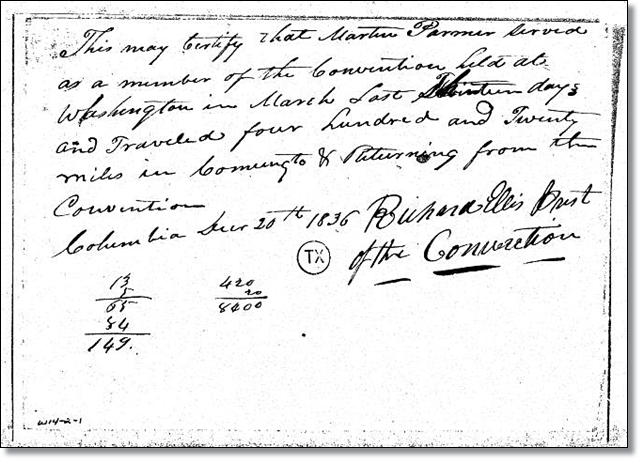
Richard Ellis' Certifies Martin Parmer as Member of Convention at Washington
Texas State Library and Archives Commission
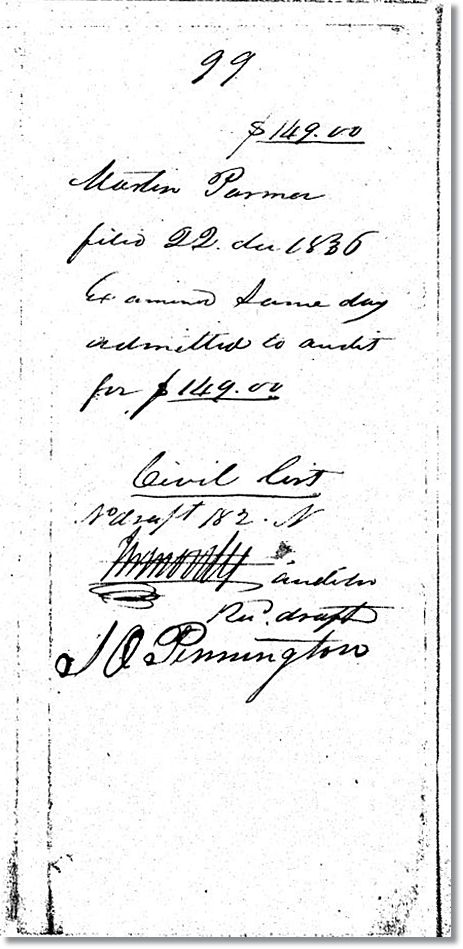
See Texas State Library and Archives, Republic Claims, Parmer, Martin, Claim #99, Type AU, Reel #81, Frame 105. Martin Parmer's claim was audited by J. W. Moody tow days later on December 22, 1836 in the amount of $149.00.
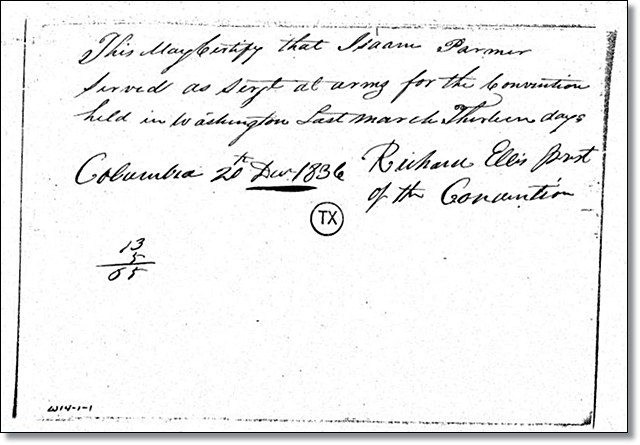
Texas State Library and Archives Commission See Texas State Library and Archives, Republic Texas Claims, Parmer, Martin, Claim #99, Type AU, Reel #81, Frame 103. Isom Parmer Sergeant at Arms Convention at Washington
Texas State Library and Archives Commission
Martin Parmer Following the Convention
Military Activities
Claim of John S. Thorn - Says Martin Parmer was his Commander in the Defense of Nacogdoches in Pension affidavit. "At this juncture, said company with several other companies then here, under the command of certain officers (Martin Parmer a part of the time, and Col. Jesse Benton another part) were detained here in active service in the defense of said town of Nacogdoches." Also see randall osborne Also see moses roberts Quartermaster Martin Parmer Resigns as Agent for Texas On Monday May 15, 1837, the following activity took place in the House of Representatives of the Republic of Texas.
ORDERS OF THE DAY.
See page 1, Telegraph and Texas Register, published in Houston, Texas, Friday, May 26, 1837, Vol. 2, No. 18.
Agent for Texas
Martin Parmer in Jasper County
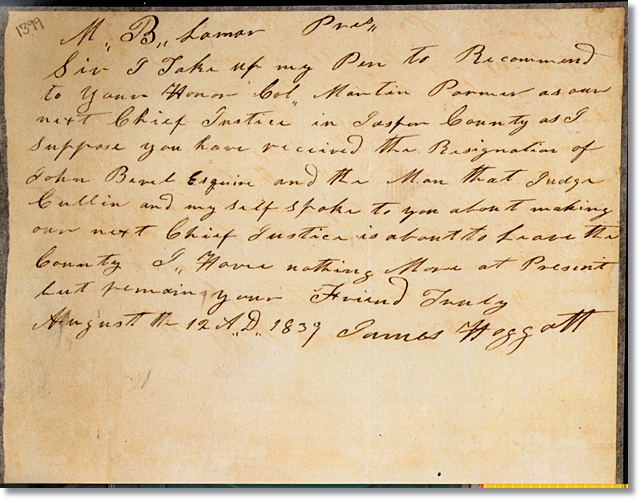
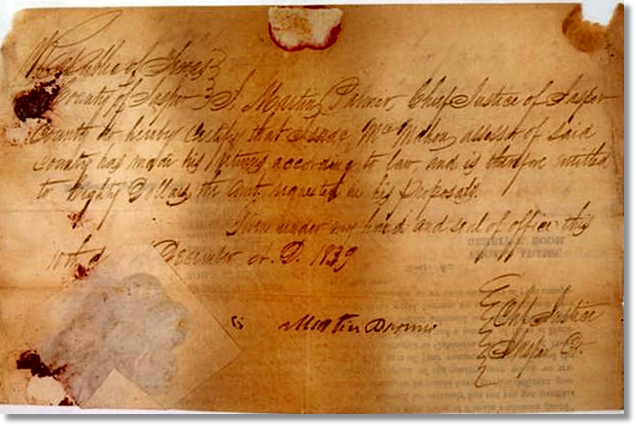
Chief Justice of Jasper County, Texas In 1839, Republic of Texas President, Mirabeau B. Lamar, appointed Martin Parmer to be Chief Justice of Jasper County, Texas. James Hoggatt Recommends Martin Parmer for Chief Justice of Jasper County
Texas State Library and Archives
Since Parmer's appointment, the Jasper County courthouse burned destroying most ot the records of Parmer's service as Chief Justice of Jasper County. There is at least one record in the Texas State Library and Archives that records Martin Parmer as Chief Justice of Jasper County.
Texas State Library and Archives
Murder See william myers claim 6880 and 7068 Isaaks 6668
Probate of the Estate of Martin Parmer Martin Parmer died at the age of 72 on Texas Independence Day, March 2, 1850. His youngest child at the time was 2. Following Martin Parmer's death in Jasper County, Texas, his widow and minor children moved to Walker County, Texas where several of Martin Parmer's adult children from his first marriage lived. The estate of Martin Parmer was probated in Walker County, Texas instead of Jasper County, Texas.
Administrator's Notice
According to probate records, this advertisement ran six times in a newspaper called the Presbyterian, [probably the Texas Presbyterian] published in Huntsville, Walker County, Texas.
Parmer County Created in 1876 and Organized From XIT Ranch in 1907
Parmer County Coin
Parmer County Sheriff's Patch
Sheriff's Department Patch, Parmer County, State of Texas
Martin Parmer in the History Books 1929 - Marquis James
Marquis James Mentions the Ring Tailed Panther in His Biography of Sam Houston The Raven On Page 201 of his Pulitzer Prize winning biography of Sam Houston, The Raven, Marquis James makes mention of "the Ring Tailed Panther."
Marquis James got the detail about Martin Parmer eating an Indian's heart wrong. Martin Parmer had killed an Indian who had eaten a white man's heart. See Fifty-Five Years Ago in the Wilderness by Thomas Parmer, 1874.
1998 - William C. Davis
On page 291-292, William C. Davis Mentions James Bowie and Martin Parmer traveling to Texas together in 1831.
1960 - Bennett Lay
Bennett Lay spends a lot time discussing Martin Parmer including most of Chapter 16, titled Rebellion. You will never guess who the leader of the rebels is and who is sleeping with Peter Ellis Bean's wife.
1967 - R. Henderson Shuffler, Director, Texana Program, University of Texas
The cartoon above is from the Texas Magazine in the Sunday, May 7, 1967 edition of the Houston Chronicle. The article, The Ringtailed Panther from the Forks of the Creek was written by R. Henderson Shuffler, Director of the Texana Program at the University of Texas. Shuffler begins his article, "Martin Parmer was a man to delight the soul of any history buff who likes his ealy Texans roughcut and rambunctious. He was a practicing character. In the words of his era, "he warn't no plain old garden variety sonofagun, but a rootin'-tootin' sonofagun with brass-bound parts." The cartoon depicts the funeral of one of Martin Parmer's favorite bear dogs. Parmer had one of his sons fetch a pastor to preach "an eloquent funeral."
Martin Parmer in Fiction 1912 - Joseph Altsheler
1913 - Joseph Altsheler
1913 - Joseph Altsheler
1934 Edition of The Texan Triumph - Collection of K. K. Searle
A Romance of the San Jacinto Campaign
Martin Parmer has appeared several times in Texas historical fiction. The first historical fiction that Martin Parmer made an appearance in was the Texan series written by Joseph Alexander Altsheler. The books in the Texan trilogy were The Texan Star, The Texan Scouts and The Texan Triumph which were originally published in 1912 and 1913. The books were reprinted many times between 1912 and the late 1940's and were to found in almost every library in the country. The protagonist in the Texan series is a teenage boy named Edward "Ned" Fulton. Fulton becomes involved in the Texas Revolution and many harrowing adventures. In his adventures, he teams up with two other volunteers fighting in the Texas Revolution, Obed White and of course, Martin Parmer - "The Ring Tailed Panther." Martin Parmer makes his appearance in the first book, The Texan Star, in Chapter 14, "The Ring Tailed Panther," and appears as an important character in all three books. As will be seen in the following quotes, Altsheler portrays Parmer as the quintessential frontiersman. Altsheler also accentuates Martin Parmer's eccentric behavior. I recommend this series enthusiastically to anyone interested in the history of the Texas Revolution. Used copies of all three books can be obtained from Ebay.com, Amazon.com or Bookfinder.com.
The Texan Star (1912)Chapter 14 - "The Ring Tailed Panther" Page 217-221
1966 - Giles Lutz
1987 - Frances B. VonRosenberg
|
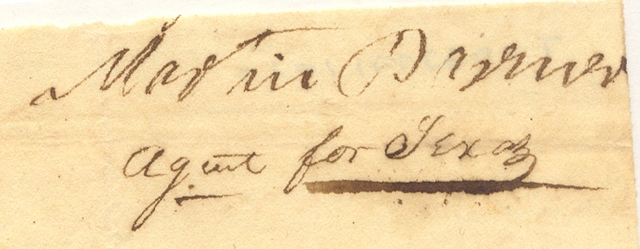

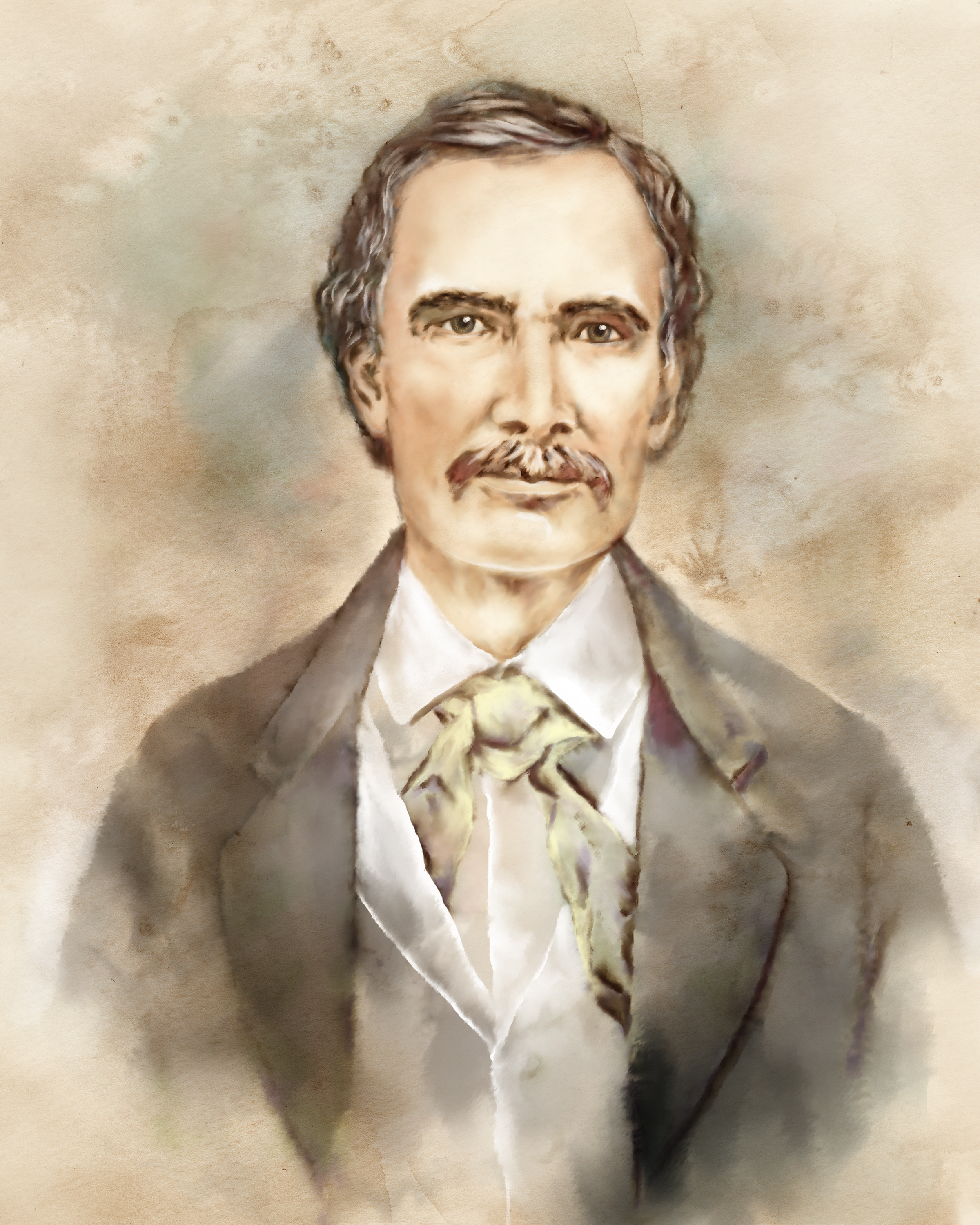
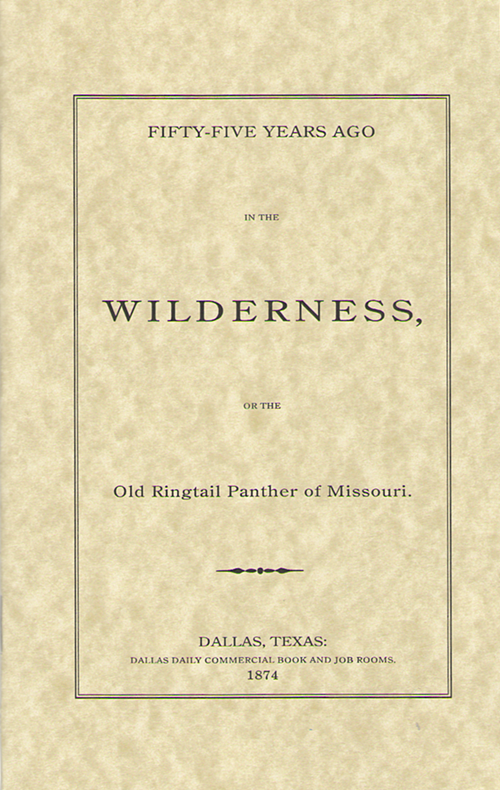
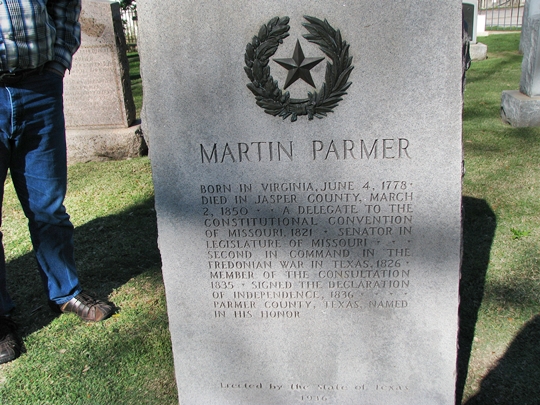
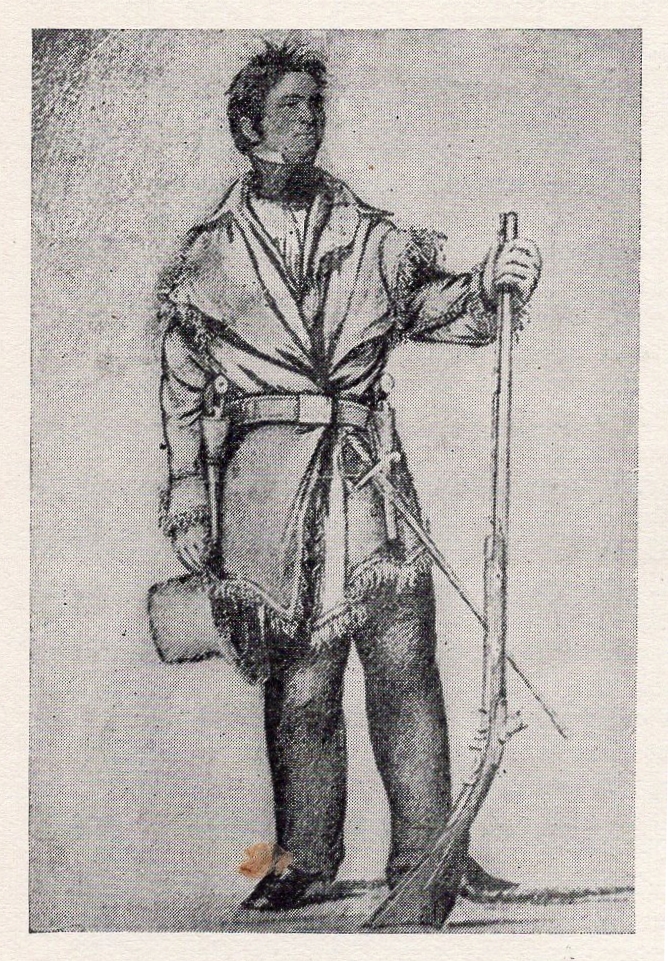

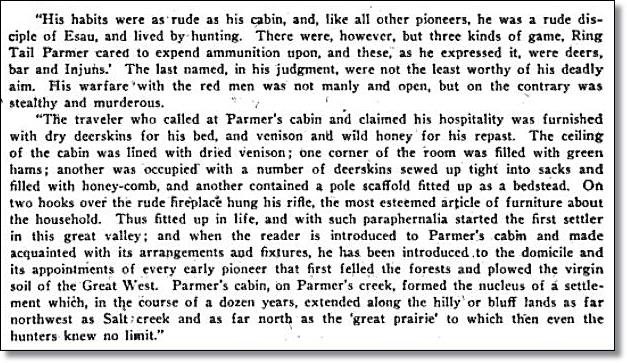
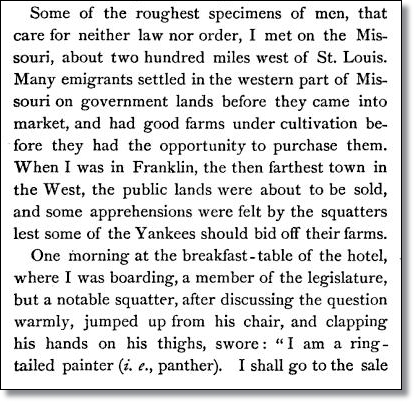
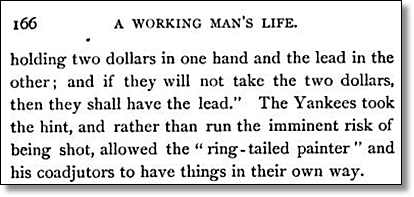
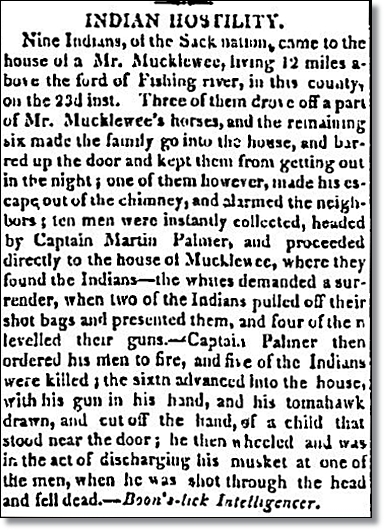
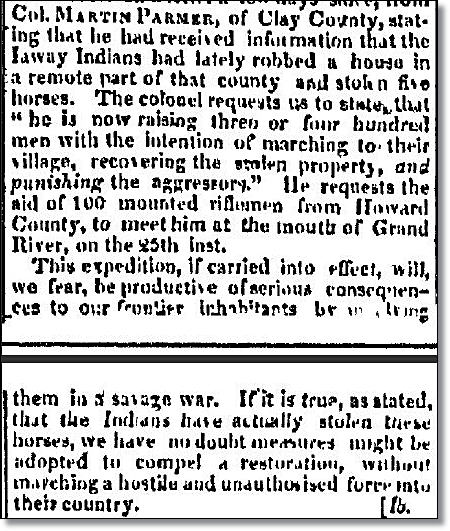
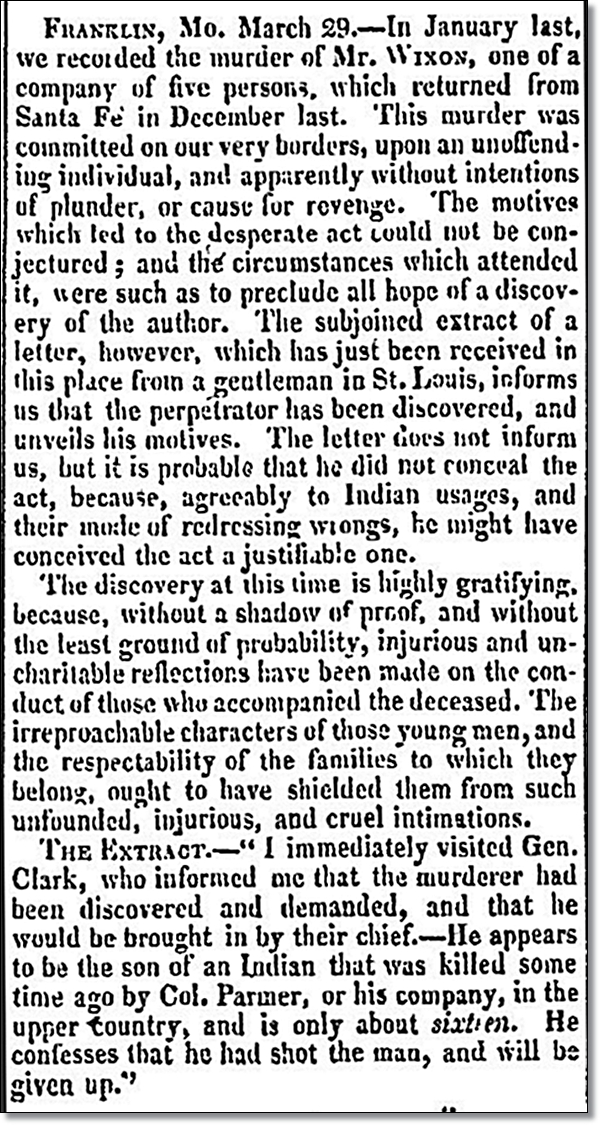
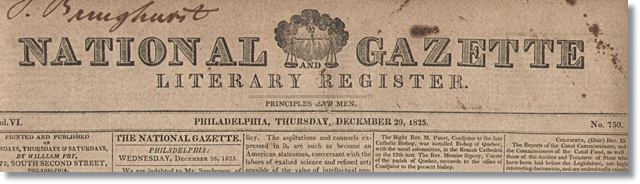
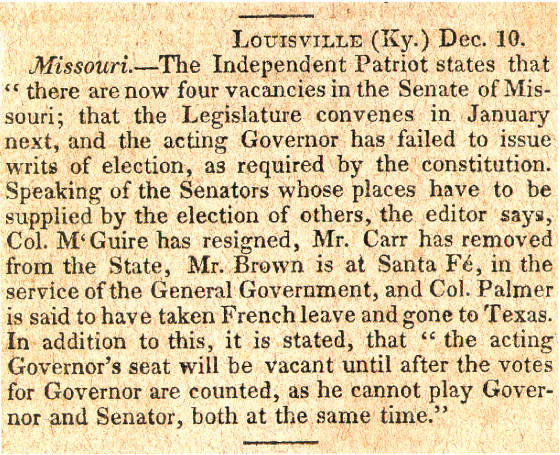
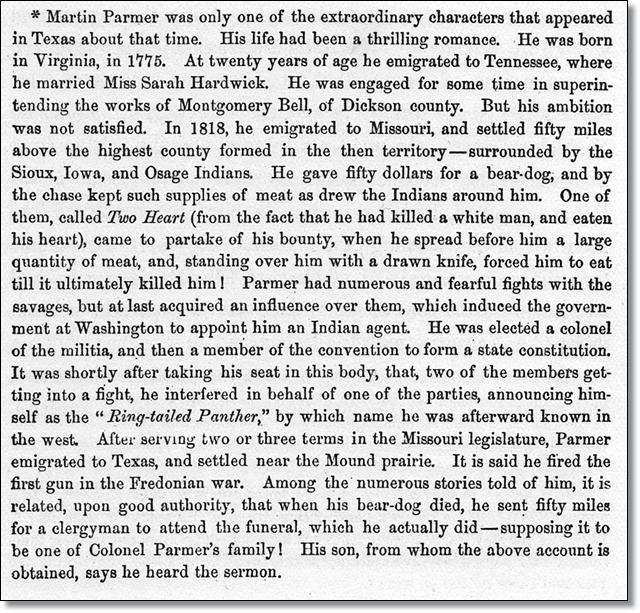
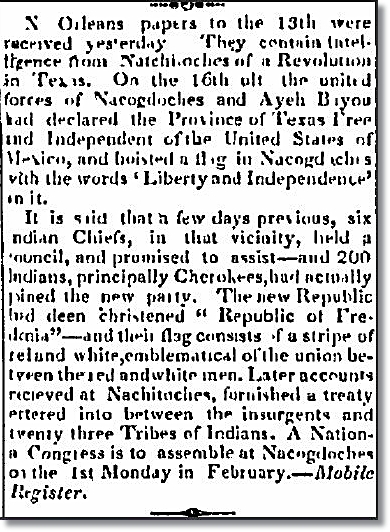
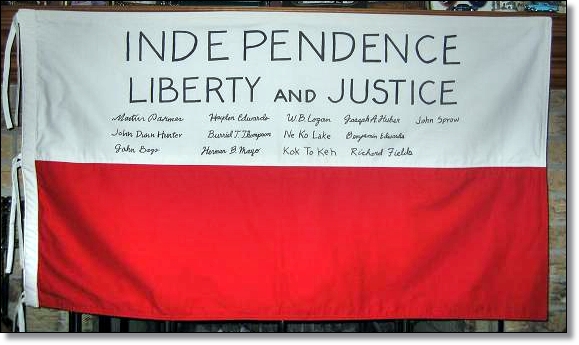
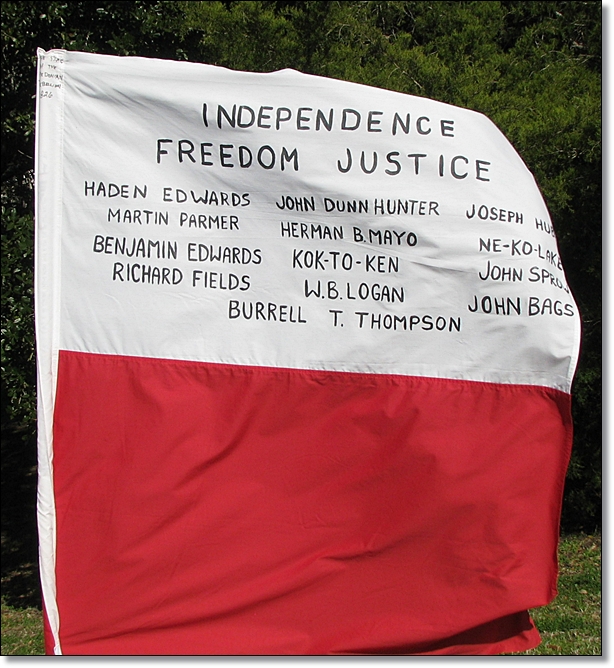
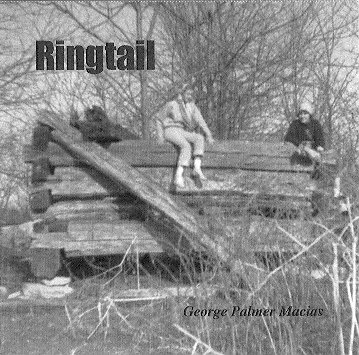
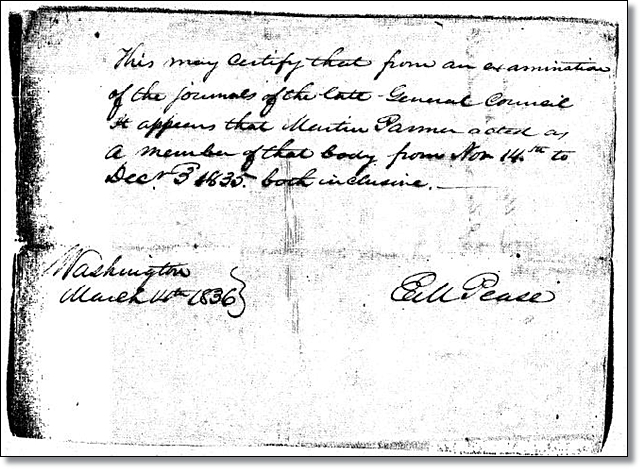
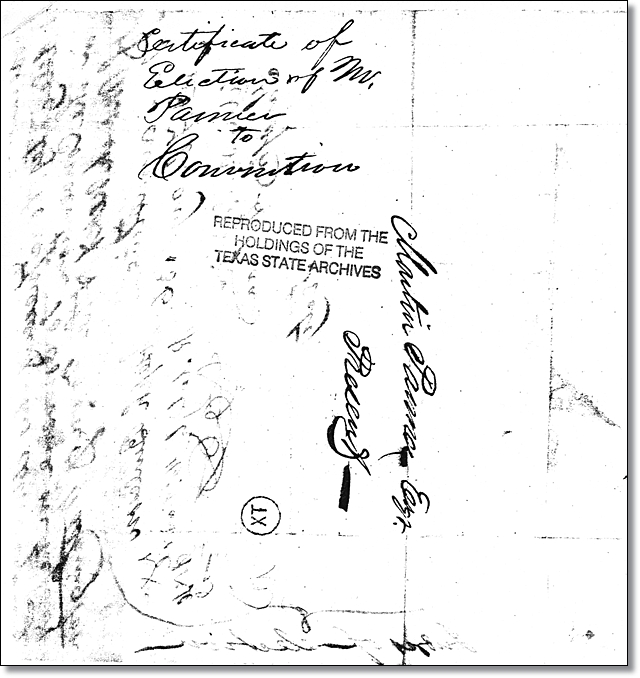
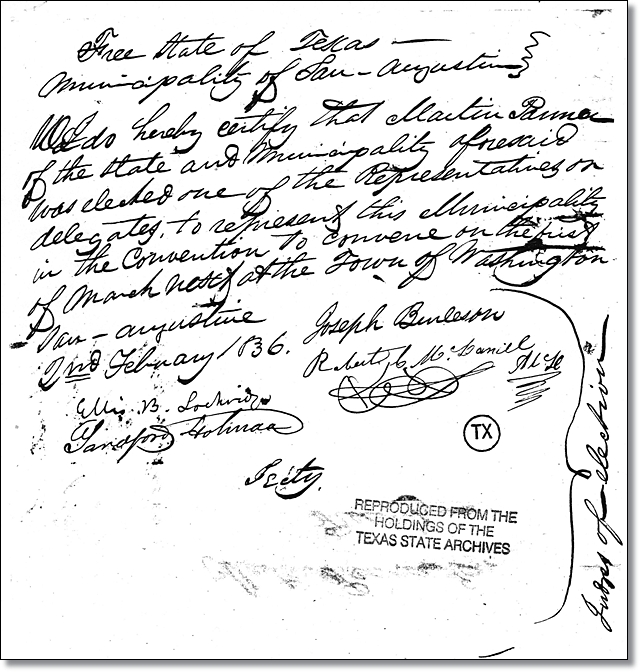
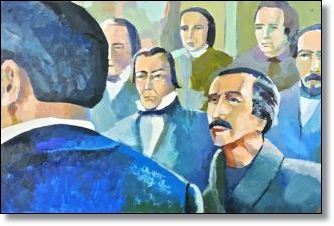
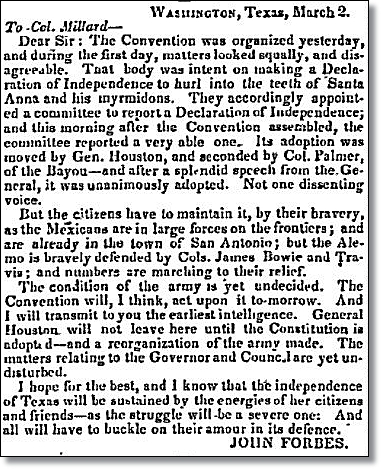
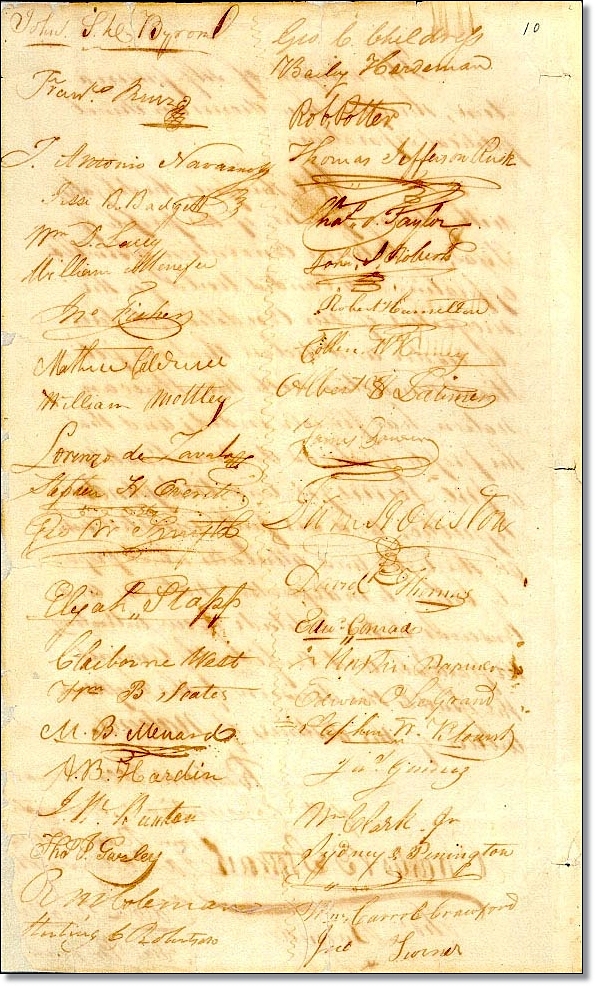
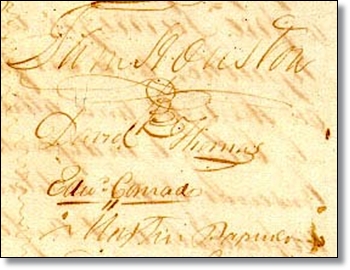
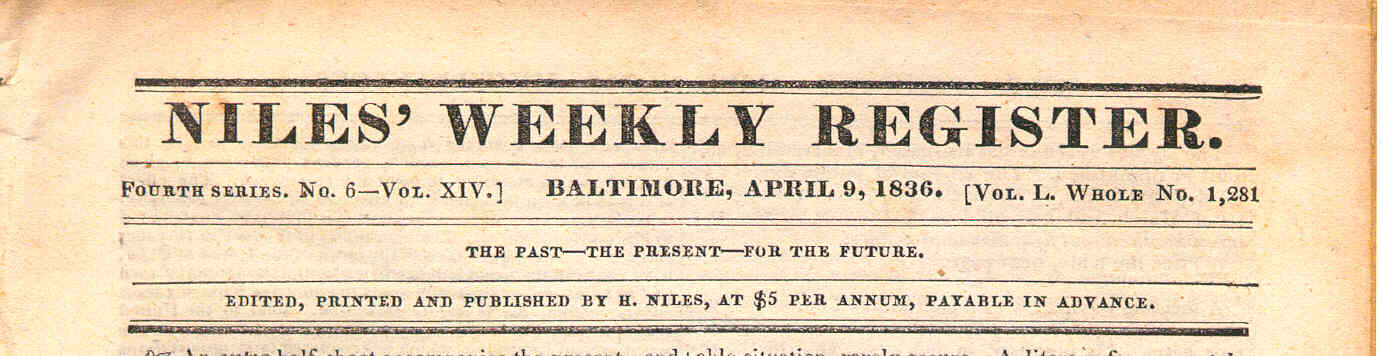
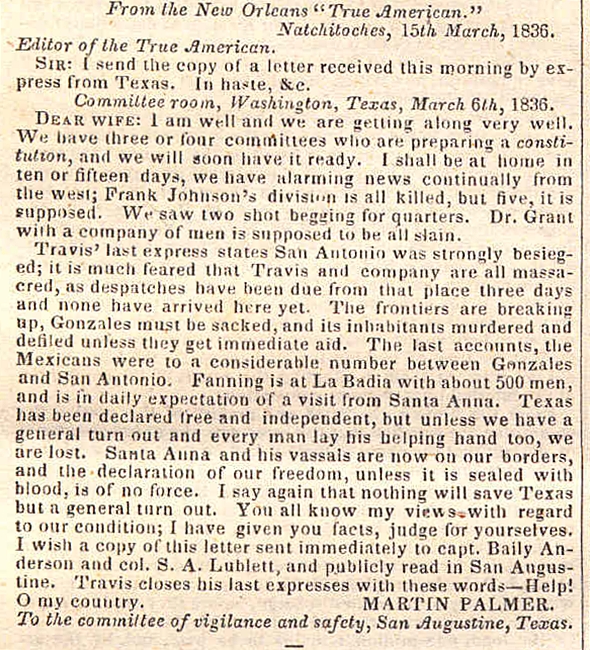
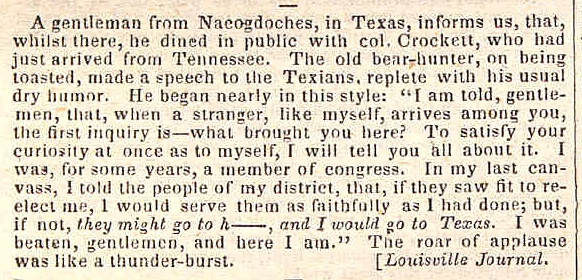
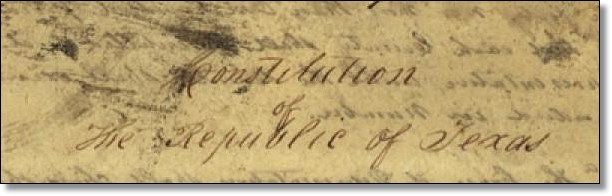
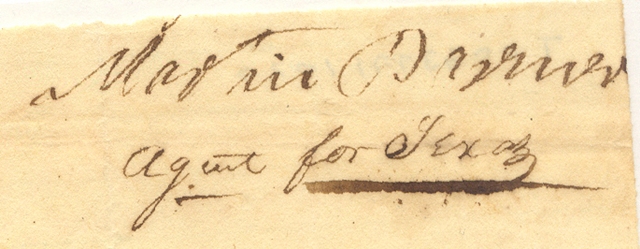
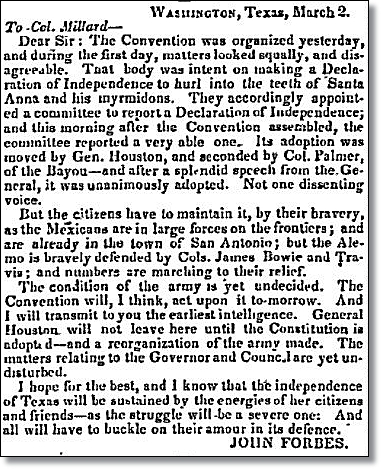
![March 21, 2011 New Orleans Abeille [New Orleans Bee]](images/New Orleans1836.jpg "March 21, 2011 New Orleans Abeille [New Orleans Bee]")